




As a leader, would you like to…
♥ have more impact on your environment and others
♥ understand, connect and manage your people more effectively (through energy, emotions and the mindset)
♥ generate greater results (more productivity, contribution, creativity and inspiration)
♥ eliminate the fear of failure: you only fail when you don`t try or you don’t learn from your actions
♥ become more effective: increase motivation and productivity of your team
♥ develop a leadership style based on consciousness and awareness, not your ego
♥ reduce your overwhelm
♥ eliminate imposter syndrome
♥ eliminate or minimise stress levels
♥ control your feelings and emotions – the 5A framework
♥ prioritise effectively
♥ use your awareness to make the best decisions
♥ use your cognition and language to control your focus and your time in the most efficient way
♥ use your resourcefulness to maximise the chance for success
♥ be more connected to your mission, vision and passion
♥ leave a powerful legacy (create more leaders, impact and change in the world)
♥ mentor, guide and inspire others so your vision and your dream lives on ….?
If so, cognitive transformation is for you.
What is cognitive transformation? – you may ask.





♥ Cognisant Leadership through Cognitive Transformation ♥
Why cognitive transformation?
» delivers greater results
» it is faster, easier and more efficient than just changing thinking
» it is much more profound – cognition has three distinct layers
» works on a much deeper level of consciousness and greatly expands self-awareness
» provides more sustainable, permanent changes
» it is the most effective way to control and manage our thoughts, emotions and energy
» it is also the best and the shortest way to effective self-leadership
» it is the key to understanding, connecting and influencing people



COGNISANT LEADERSHIP PROGRAMME
in MODULES:
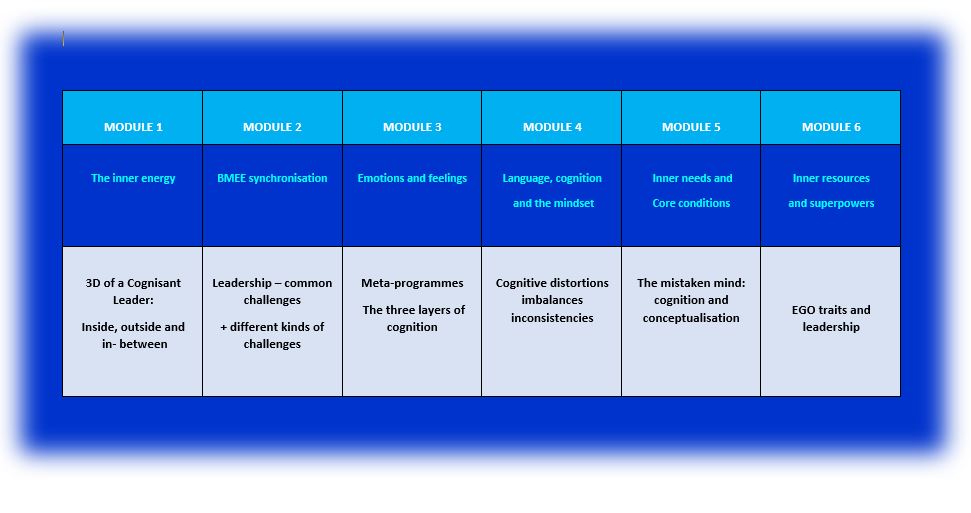
MODULE 1 – YOUR INNER ENERGY
MODULE 2 – BME SYNCHRONISATION
MODULE 3 – YOUR FEELINGS AND EMOTIONS
MODULE 4 – YOUR MINDSET – COGNITION AND LANGUAGE
MODULE 5
Leadership as coaching – conditions and needs (service – based vs ego – based leadership style)
MODULE 6
The inner resources and superpowers in leadership: problem solving, creativity, resilience and resourcefulness
Additional modules:
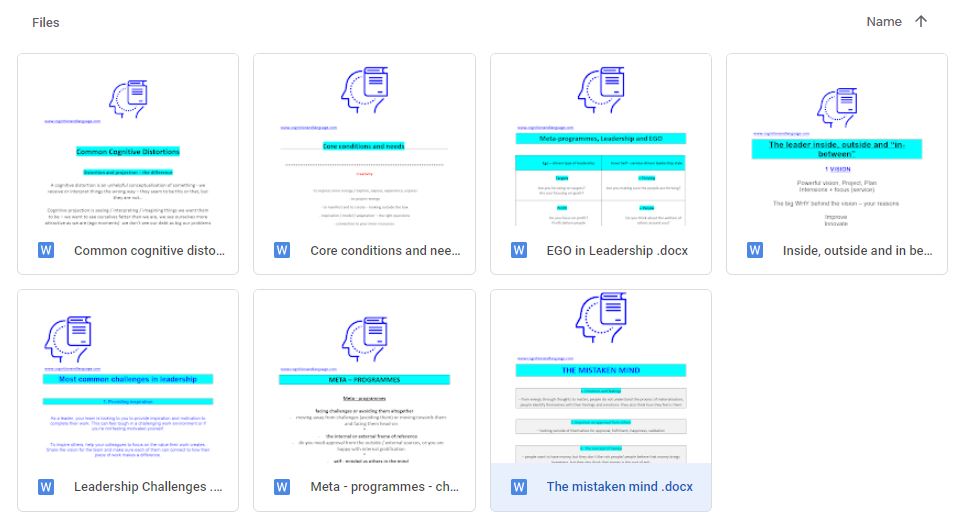
Inside, outside and “in-between”
Leadership Challenges + different kinds of challenges
Meta – programmes and leading others
The mistaken mind – common misconceptions and cognitive biases
Ego in Leadership



YOUR PESONAL JOURNEY: BECOMING A COGNISANT LEADER


Cognisant Leadership Programme
PERSONAL DEVELOPMENT programme for leaders,
and anyone who is currently in charge of people or plans to become a leader in the future.


When you become a member, you will have access to:
– extra materials and resources
– extra Live training and sessions, extra bespoke materials
– regular, extra Q&A sessions
– connections and community
ALSO:
– you will be able to share your progress and accomplishments in the group
– your own Facebook live sessions
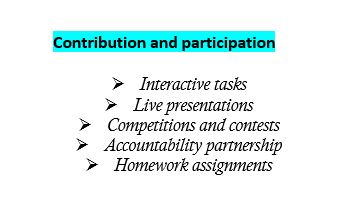
– presentations
– you may want to pair up with an accountability partner
– you will share your valued opinions, feedback and insights
– you will present your findings and project work
– you will be encouraged to move forward and share your progress
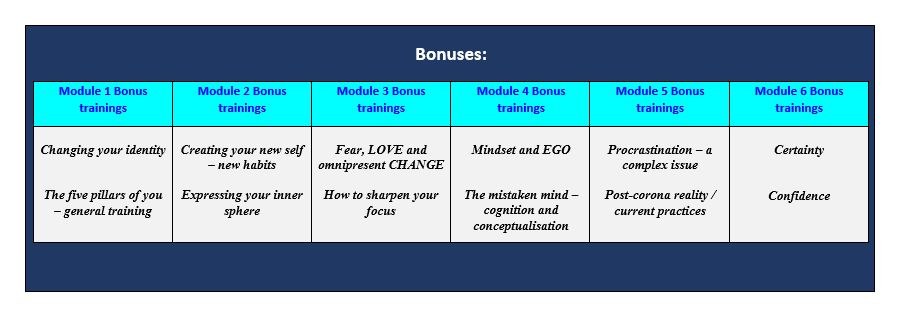
12 BONUS training sessions
(see the table below for more details)
******************************
About the group:
The group size allows for more than a satisfactory level of intimacy, privacy and attention level that leads to great results.
The group-level creates a sense of community and develops really strong, meaningful connections between the members. There are very many opportunities for support, understanding and acceptance from the group members.
Although this is a group environment, there is plenty of room for extra attention and additional assistance – within the time frame devoted to the group.
Within the group, there will be a place and time for feedback, progress and transformation assessment.
As in a 1:1 setting, all the group members will be, to some extent, in control of the pace and the degree of the transformation they wish to undergo. However, within the group, it may require a bit of effort to keep up with the rest of the members.
You will be solidly supported with the implementation of the strategies, and techniques suggested in the process. Your progress will be assessed within the group and the weekly calls and when appropriate, the strategies and techniques used by you will be adjusted to ensure maximum effectiveness.
There will also be a great deal of opportunity to practise and implement what has been covered in each session with other group members.
You will have a chance to contribute to the group through interactions with other members and through sharing your experiences with the group.
Many group members will be featured in podcasts, blogs, live calls and webinars.


WHAT IS INCLUDED IN THE MEMBERSHIP?

MAIN MODULES and ADDITIONAL MODULES
BONUS MODULES AND TRAINING SESSIONS

What do I do next?
If you would like to join Cognisant Leadership Group but you are not sure how it may benefit you, you should speak to me.
Please fill out a short questionnaire and book a free assessment session here.
Please get in touch to be sure that the programmes and the offer are the right fit for you. I will not be willing to work with you if I feel that you are not ready to transform into a leader yet, or if you will not commit to what you intend to achieve. I will then make appropriate recommendations for you and wait until you are ready to spread your wings.
What will happen when I contact the company / the person / take the next step?
The first step would be to determine whether you will handle the transformation and how well. You will be invited to a 1: 1, private discovery session where we establish the best possible way forward for you.
– you will discover where you are at with your cognisance as a leader
– you will develop a bigger picture of conscious leadership and have a clear vision of yourself as a cognisant leader
– you will have a clear idea of what your next steps are
– you will, most likely, experience one or more transformation
The bottom line here…
Absolutely nothing to lose. I want you to feel safe and reassured that the offer is for you, so we avoid any chance of disappointment.



THE FIRST 50 MEMBERS will have an opportunity to be assessed before they start the programme
will get personalised feedback on their workbook answers.
Also, they will receive
free, additional resources to help them succeed in becoming a cognisant leader.
Hurry, the first 60 spots are going to be taken fast!
Your next step towards becoming a Cognisant Leader:
Please get in touch if you worry about the suitability of this membership programme for you.
Have you decided to become a cognisant leader? Great!
Subscription fee:
ONLY
£197 per month!
Become more self-aware, more impactful, and influential- start today, start here, start now:



Subscribe with PayPal below
Subscribe with Stripe – choose the best option for you below
To find out more about the Mastermind and Coaching click here
Please note:
The guide is included in the COGNISANT LEADER MEMBERSHIP PROGRAMME.
Spiritual, Emotional and Mental Challenges, Needs a Capacities.
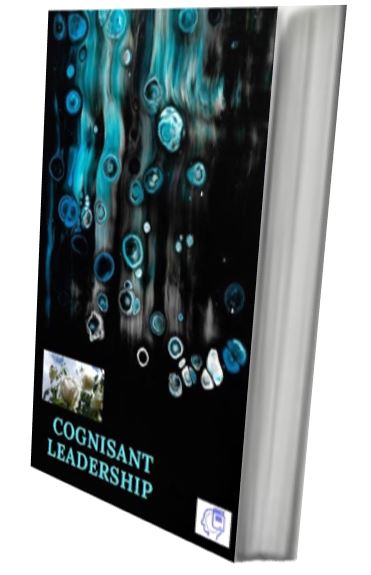
~ AN EBOOK ~
A comprehensive GUIDE to Cognisant Leadership
100 pages of different aspects of leadership described above on this page. The guide includes a series of questions about each aspect of cognisant leadership for you to think about and answer.


Cognisant Leadership
Why should you become a cognisant leader? ………………………………………..…. page 2
What makes a leader – a cognisant leader? ………………………………………….. page 3
Why cognitive transformation? …………………………………………………………….. . page 3
What is cognitive transformation? ……………………………………………..……………… page 4
The 5 Es of inner sphere`s journey ……………………………………………………….…. page 5
– the journey of cognisance in five stages
– what needs to be determined?
– what are the three layers of cognition?
How does human cognition work? ………………………………………………………… page 8
– cognitive imbalances, inconsistencies, biases and distortions
– cognitive meta-programmes
It is much more than cognition and thinking ……………………………………… page 10
– what is the solution, then?
Your three-part inner sphere transformation……………………………………… page 11
Cognitive transformation – how does it work exactly? ……………..…….page 15
Pillar 1 – inner energy …………….……………………………………………………….… page 19
– inner energy
– feelings and emotions
Pillar 2 – Inside outside and “in-between”……………………………………………… page 26
– cognisant leader inside
– cognisant leader outside
– cognisant leader “in-between”
Pillar 3 – Challenges…………………………………………………………………………………… page 40
– most common leadership challenges
– different kinds of challenges: spiritual, emotional, mental
Pillar 4 – Mindset, language and cognition …………………………………….……… page 53
Classic meta-programmes and leadership:
– cognitive meta – programmes
– emotional meta – programmes
– semantic meta–programmes
– social meta–programmes
– Cognitive distortions and imbalances
Pillar 5 – Core conditions and inner needs……………………………………………… page 53
Core conditions and needs
Also: growth, safety, power, control, expression
Mental, emotional and spiritual needs …………………………………….…… page 70
Ego–based leadership style ……………………………………………………………. page 71
Pillar 6 – ………………………………………………………………………………..…………… page 73
– inner resources
– inner superpowers
Your journey: becoming a cognisant leader …………………………….…… page 78
– six steps to cognisant leadership
– a solid framework for becoming more cognisant
Some questions you may ask yourself ……………………………….……………… page 91
Additional modules at a glance …………………………………………………………… page 96
Completing the programme ……………………………………………………………..….. page 99
Ego in leadership
Eliminate the ego from your leadership and free yourself from its impact on your thinking and decision making.
This file is included in The Cognisant Leader Membership programme.
Common Leadership Challenges
How to face common challenges in leadership with a range of strategies and ideas for facing any adversity.
This file is included in The Cognisant Leader Membership Programme
.


FREQUENTLY ASKED QUESTIONS
What is this membership about?
This MEMBERSHIP CLUB is a place where people in charge transform into powerful, conscious leaders by being aware of their meta-programmes, managing their cognition and language and controlling their emotions and being in charge of their energy.
It is also a place where people master meeting their own needs and the needs of their team members. They also explore access and use their inner resources and begin to utilise their inner powers.
This is where they change their management and leadership style and create the opportunity for a greater impact on others, stimulate more growth on every level, increase productivity, empower, and inspire others so they lead others in the future.
This is the club where members are solidly supported with personalised feedback and receive bespoke materials and full, 1:1 attention.
Who is the membership for?
This group is for someone who is in charge of working with a group of people. It is for people who would like to increase their influence on others and magnify their impact on their immediate environment and beyond.
managers, supervisors, leaders, group leaders, business owners, entrepreneurs
This group is also for people who would like to become more powerful and influential leaders or change their current leadership style and try new ways of making a lasting impact in the world.
Cost:
This group is paid. See the price below.
Schedule a discovery session if you have any questions about becoming a powerful, cognisant leader.
How much time will it take?
It can take as little time as you wish. You can join or leave and session, any task – anytime you want.
You can work at your own pace and at times that suit you and fit your timetable.
As a leader and a member of the Leadership Club, you will be a part of a small, private community where you will have a chance to plan, strategise and practise your new approach.
You will get all the attention and support you need and fully deserve. You will be in a highly supportive and friendly community where you will have an opportunity to grow your awareness and become a truly conscious leader.
What are the outcomes/results? When will I see the results?
The main outcome is to make you more aware of your leadership style and enable you to adjust and adapt to new strategies and approaches.
The Club is a place where you get full support in working on your cognition, and your new leadership style. Personal feedback and suggestions as well as bespoke materials will be provided.
The ultimate goal is to transform you into a more cognisant leader with a clear goal and a powerful vision, a leader who understands self and others well and can use that awareness to empower, inspire and lead others.
The results will depend on the willingness, mental, spiritual and emotional capacity of an individual. It is particularly important to note that the content and any training session will boost that capacity in a significant way.
In terms of the timescale and desired results, you are likely to see the change as soon as you implement strategies and take action. It is up to you.
The more you focus on your improvement, the faster it will happen.
How little hassle it will be?
Answering questions, planning and implementing a new leadership style. You will be able to do everything at your own pace and to a degree, you are comfortable with.
You will be supported in implementation and putting strategies into practice.
What are the risks involved?
Your inspiration and motivation to become a new type of leader may not be strong enough, to begin with. You might be pulled back by the familiarity of your current situation, your current position. You may not be willing, hungry and coachable enough. You need to magnify all three elements for maximum success. You might find that your commitment level goes down and you need to know why. You will get support with finding that out.
You must be aware of the process and potential forces that will try to pull you back. You must be vigilant and detect any signs of pressure pulling you in the opposite direction.
You may experience strong resistance to any change in your mind – you might find that you are upset, disappointed or even angry about your situation. Your mind may want to deny it altogether.
It is all perfectly normal – a transition between being in total control of your meta-programmes and having control over them. I have experienced similar feelings and thoughts. You need to remember though that it will feel different to have the power over your thinking and your thoughts. You will be in control of that process and I guarantee that it will be worth it. Things will improve when you change your identity and align it with your new habits and your vision.
Being able to observe your thoughts and most of all, not identifying with them will set you free. You will finally be able to see the dichotomy in everything and you will begin to see opportunities instead of obstacles. That is power.
One caveat though – you must be ready.
To become a true leader, you must control your thoughts and feelings to some degree. There is no better way to do it than to gain awareness of your meta-programmes and your cognition.
You will change your existing frame of mind into that of a true leader. You will clearly see what being a leader means and others will be extremely grateful for your leadership and will admire your new style, your confidence and authenticity.
Who is this company?
I am an Independent Cognition and Language Specialist. I have studied Cognitive Linguistics and obtained an MA title in 2004.
I have been lucky to be guided to where I am now.
The experience of two cultures and knowledge of two languages have given me a unique perspective and a powerful insight into human cognition, how we generate and use language, and how we communicate and conceptualise things.
I am an expert in detecting and correcting any cognitive distortions, inconsistencies or imbalances which most likely are causing a mental or emotional problem.
Coming from a background where cognitive distortions and limiting beliefs are prevalent, I have developed an awareness that helps me to control them and correct them, whenever necessary. I have identified almost every single most common cognitive distortion there is and by becoming aware of them, I gained power over them and ever since I have been able to manage them efficiently.
I am on a mission to assist people in correcting those limiting beliefs, and cognitive distortions as I experienced how uncomfortable, how limiting indeed, and how destructive and painful they can be.
If you are suffering emotionally, mentally, or spiritually, the chances are that the underlying cause of that suffering has roots in your cognition. It is time to regain control and power over our thinking, emotions and energy and finally feel free.
If you do not influence people to the extent you expect if you don’t recognise the motives behind people`s thinking, their feelings and their actions that means you need to expand your cognition and discover meta–programmes.
My cognitive distortions were shaping my reality, they impacted my every decision and choice and almost destroyed my life – every aspect of it. I`m afraid, it was that bad. I discovered that I had no control over my thinking and to my horror, as an inherited set that cognition began to manifest, and history was repeating itself yet again…
It took me a few long years to finally work out what was really going on. That means great news for you. You don’t have to wait that long as I have some great shortcuts and I am beyond excited to share them with you.
You don’t have to take my word for it. Experience transformation first-hand. Listen, commit, get involved, answer the questions and act – implement. The only wrong way is not trying at all.
During my career, I have experienced many so-called leadership “styles” – most were based on self-interest, more often than not on an incredibly strong ego and astounding lack of compassion, empathy and yes… leadership…!
Sadly, that is the norm in many places and institutions today – the third decade of the twenty-first century.
I aim to create conscious leaders as awareness is the key to empathy, understanding, connection, and compassion and these are the foundations of any relationship. Relationships are the ultimate quality of our life – who can object to that statement? Thank you Tonny Robbins.
Most leaders lead using the top-down style, however, the bottom-up style is much, much more effective, productive and satisfying for both sides in a working environment. I am here to change that.
Current practices are simply unsustainable.
How do I get my questions answered?
You can ask any questions via e-mail, through contact forms on the website, in the group(s), during meetings and over the phone.
The most important bit is… ask, ask, ask.
As a club member, you will have much bigger access to support, and feedback and you will have more opportunities to ask any questions you may have.
Can I trust this person? Company?
Isn`t it really sad that trust is really hard to find these days? Many people promise so much but deliver so little… I am not asking for your trust because you, like most people, have only a little bit of it, if any left at all.
Trust levels are at an all-time low now and something is wrong with them: underlying values or lack thereof.
I want you to give yourself a chance and explore, and experience your own meta-programmes, your own cognition. Then you`ll see whether you are material for a conscious leader. Cognitive transformation is not exactly for everyone.
I will not tell you what to do, I won`t make any suggestions. You will be in control the whole time as only you have all the answers. I will just help you to find them.
I invite you to experience it for yourself. Experience transformation first-hand.
Listen, commit, get involved, answer the questions and act – implement. As I mentioned earlier, the only wrong way is not trying at all.
It is very empowering and fun to finally create ourselves – the way we should be, the way we want to be. It is exciting to meet your true Self. By the way… prepare to be blown away by your own greatness. Most people are frightened by it… sadly…
Prepare to be surprised by the power you will gain, the confidence and authenticity that will show up and the size of the impact you will have on your immediate surroundings and beyond.
***
Toggle Content
What is quiet quitting?
What is quiet firing?
Why did the western world experience great resignation?
The current damaging and maladaptive practices at the workplace and what to do about them.
Why do people really quit? It`s not only “the boss”.
What do people want from their workplace today and in the future?
How do we look after our employees mentally, emotionally and spiritually?
10 + Core conditions that have to be met for people to thrive at the workplace.
- the necessity to safeguard the health of the workforce and communities is now obvious and in plain sight
- well-being is a top priority for companies and leaders more profoundly now than ever before
- there can’t be productivity if people aren’t well, but this has also certainly extended to family members recently
- supporting employees in every way possible – mentally, emotionally, financially, socially and spiritually is the fastest way to prosperity in all shapes and forms
- increased leaders’ awareness that they and their teams need time and support to take care of themselves and their loved ones
How to look after the team members` mental and emotional well-being.
How to create core conditions for people to thrive in.
How do we support employees mentally, emotionally, financially and spiritually?
The great U-turn: how does the job serve people – not how people can be used for the benefit of the company, institution or the system as a whole?
Understand the mindset, emotions and energy to positively influence people.
Meet employees’ needs and create core conditions for them to thrive.
Empower employees and encourage them to use their inner resources and their inner powers to create more and better quality and to be more inspired.
- growing economic uncertainties and cost of living crisis are currently intense
- people look for stability at work
- employees will want to work for companies that have an essential quality: trust
- culture and leadership that people can trust is fast becoming a differentiator
- trust in leadership and societal institutions is at an all-time low right now
- trust is something more companies are designing for as part of their leadership development programmes
- without trust there is a sense of lack – people will not buy, they won`t be generous, benevolent
- leaders will continue to be central in building trust and securing employees` loyalty for the foreseeable future
How do you develop and maintain trust? What is trust?
How do you develop credibility?
How do you lead in challenging times?
How do you deal with the change and the fear of the unknown?
- the great shake-up for leadership skills is happening right now
- traditional leader skillsets including communication which could once be mastered, now need to be refreshed and virtual contexts added
- leaders will continually need to refresh and develop skills – including internal abilities: mental and emotional abilities to cope with challenges
- soft skills
- trainability, flexibility and internal qualities gaining importance in the process of hiring
- empathy, connection and relationships are prioritised over transactions, deals
- there is an increasing need to expand mental, emotional and spiritual abilities to lead better
How do you develop soft skills in leadership?
How do you develop the empathy needed in leadership?
How do you lead in virtual/hybrid environments?
How do you improve your ability to cope with challenges? How do you increase your mental, emotional and spiritual capacities to cope with challenges better?
- employee`s experience surged to the top, hot topics around the workplace
- both 2020 and 2021 were key learning years for employees and employers
- professionals developed high expectations in terms of how and where and how much they can work
- huge increase in work flexibility and alternate modes of employment have contributed to the fluidity of the workforce and increased the pace of turnover which now is being addressed
- there’s an increasing desire for skill and career development that companies cannot afford to ignore – the ability to face challenges and changes, mental, emotional and spiritual agility, resilience and a clear alignment with who we truly are
- it will be more important for top talent to not only feel valued but be aware of their growth potential for the future: validation = improved retention growth = better results
How do you create optimal conditions for your team members?
How do you make your people thrive?
How do you meet your employees’ emotional, mental and spiritual needs?
How do you develop your people?
How do you grow new leaders?
How do you celebrate, acknowledge and validate your people? – multi-levelled validation.
- the importance of embracing diversity, equity, and inclusion has never been more prominent
- unleashing the potential of your employees – creating a growth container is becoming a trend
- creating a better and more engaged workforce that leads to more profitability
- where there is greater representation, there is greater performance and more revenue
- leadership increases its focus on diversity, there are benefits to retention. recruiting, profits, and better performance, in particular
How do you engage employees?
How do you inspire and motivate your team members?
How do you involve and include your people?
How do you include, involve and engage different people with distinct energies, emotions and mindsets?
How do you collaborate with others and how do you facilitate collaboration between different mindsets, emotional beings and spirits/energies?
Future–based leadership.
Emotionally agile leadership – how to manage and lead with feelings and emotions
- the frequency of burnout in a business is based on factors that are directly linked to leadership style
- constantly changing or unclear instructions, an unrealistic workload, and low emotional reserves (emotional capacity)
- burnout has been even more abundantly present since the COVID-19 pandemic
- employee well-being and engagement: engagement decreases burnout, with an increase in productivity and well-being, but when engagement and well-being decrease, burnout increases
- empathy and emotionally agile leadership is the key to success
- instructions have to be clear and if not – clarifying them
- keeping in touch with both: remote and in-person workers to ensure that the workload is realistic and not overburdening
- checking in on the emotions of employees and making sure that their mental health isn’t suffering
- leaders can prevent burnout in their teams and they must
- there is an increased emphasis on mental health and employees are noticing the trend
- many people are weighing up their personal health needs against their current role requirements and choosing resignation over allowing their job to interfere with or damage their mental health (health before wealth because your health IS your wealth)
- it is imperative that employers care about, prioritise, and address the mental health needs of their employees – not only mental but emotional and spiritual needs too
How do you identify and describe your energy and your emotions?
How do you read, understand and process your emotions?
How do you recognise maladaptive mechanisms used by people to cope with their feelings and emotions?
How do you determine possible functions and messages carried by emotions?
How do you cope with emotions of the other people?
- baby boomers, Generation X, Generation Z, and millennials are all working side by side in a multigenerational workforce
- different values and working styles are likely to collide
- Are you ready for Gen Alpha?
- senior employees can easily be a few decades older than a company’s youngest workers
- the need for leaders who can adjust their leadership style according to who they’re managing
- each generation comes with its own cultural context and economic background, and so requires different leadership skills
- a multigenerational workforce has a great opportunity to learn from one another and foster a culture of collaboration, teaching, and understanding
- leaders need to be more flexible, accommodating and equipped with skills to tackle the differences and potential conflicts of interest in a multigenerational team
How do you understand other people – mentally, emotionally and spiritually?
How do you deal with and resolve conflict in your team?
How do you manage people`s energy, emotions and mindsets?
How do you set up an environment of learning, collaboration and understanding?
The difference between male and female leadership styles.
Current leadership practices – too masculine and out of balance.
Feminine vs masculine styles of leadership and how to keep them both in balance.
- authenticity in leadership is the key to success
- leaders who create space for thoughtful, honest conversations about real issues that impact their team will thrive now and well into the future
- organisations are investing in leadership development skills to teach leaders to function in an authentic way as it creates more trust
- how can the workplace be improved through authenticity in leadership?
- authenticity also improves employees` productivity, creativity, trust between employees and leaders, relationships between co-workers, and produces positivity in the work environment
- authenticity starts at the top, with leadership that communicates effectively and provides constructive, honest feedback with an opportunity to practise and master a required set of skills
How do you become authentic as a leader?
What does being authentic mean?
What is the foundation of authenticity?
How do you encourage authenticity in others?
- leaders need to stay responsive and adaptable – more cognisant than ever
- leaders should adopt a flexible way of thinking and think beyond their usual way of thinking – think outside of the box
- different perspectives that can offer different insights, by sharing their knowledge, employees can help their teams find solutions and grow
- trust and respect are important for team members to feel psychologically safe and supported
- there is also mental safety, emotional safety, social and financial safety
- building relationships with others and offering a safe place for opinions and risks where employees are able to communicate and build upon ideas, work through hardships, and support one another to get desired outcomes
- one part of being an adaptable leader is adapting your leadership style to different contexts and situations – having different ways of thinking and acting for different occasions
- the most effective leaders adapt their leadership style to different contexts and situations really well and fast
How do you stay on top and up to date?
How do you adapt to the new environment?
How do you introduce /communicate change?
How do you navigate through changes?
Cognisance as a key to staying relevant and up to date.
A growth mindset as a key to constant improvement.
How do you become flexible?
- shared ideas and values influence how your employees think and behave
- developing a healthy culture where teams feel safe, comfortable, valued, and supported is critical in any workplace today
- having the right improves employee engagement, retention, performance, and innovation, as well as overall business profitability
- working on company culture has been proven to have a measurable, tangible impact
- more people are working remotely, company culture has changed immensely and there is an increasing demand to adapt
- by establishing core company values and goals, while including, involving and engaging every single person in a team, the desired culture can be created
- showing appreciation, asking team members what they want and need, offering support, and asking for feedback goes a long way in growing a company`s specific culture
- letting the company mission and vision lead culture is the first step toward ensuring a remote or hybrid culture that is well established and maintained
How do you ensure core conditions for your team members?
How do you communicate your vision and your mission?
How do you include, involve and engage your team members?
How do you align your values and your priorities with how you feel, what you say and what you do as a leader and how do you keep your team accountable for what they say and how they act?
Conflict resolution
- workplace conflict can happen for many different reasons
- disagreements about work procedures, different or unmet needs, interests or ideas of employees and basic personality clashes
- It is helpful for leaders to acknowledge the impact of workplace conflict and know how to resolve it quickly and effectively
- leaders can build consensus among your employees to save valuable time and lead to improved cooperation, enhanced productivity, increased employee motivation and greater employee retention
- conflicts are an opportunity for growth and change and should be used to generate improvement
How do you resolve conflicts among the team?
How do ensure that your employees are heard, acknowledged and validated?
How do you set boundaries in a conflict of interest?
The ego and the needs of the employees – are the most likely foundations of a conflict.
How to use conflicts to grow your team
Coping and dealing with change
- a competent leader is vital in helping employees cope with change by understanding what drives it and the uncertainty that surrounds it
- it is critical to know the different ways in which people respond to change
- how to use change to learn a different, more effective and productive way of doing things
- focusing on challenges brought on by change – addressing them and learning from them
- acknowledging the importance of resilience, opportunities presented by a change and understanding steps to use change positively by evaluating it and applying new processes or ideas for success
How do you cope with change?
How do you communicate change?
How do you adapt to change?
How do you deal with the fear of the unknown?
Problem-solving skills
- problems are inevitable
- developing problem-solving skills is extremely helpful for leaders to learn how to identify problems as they arise
- identifying effective solutions, studying different methods for problem-solving can help leaders prevent or approach difficult situations in a positive, relevant and successful manner
How do you solve problems?
How do you look for solutions?
How do access your inner resources and superpowers to solve problems?
What questions do you ask? Do your questions produce answers and solutions?
How to utilise a problem to create new solutions.
Virtual leadership – how to lead virtually?
- virtual leadership training can help you acquire the skills needed to lead your digital team to success
- as a leader you need to be effective in communicating without face-to-face interaction
- development of high emotional intelligence to steer team empowerment, culture, collaboration and engagement – even in a virtual setting
- maximising your online tools while perfecting your technical skills to use the tools efficiently is a must today
How do you manage a virtual team?
How do you assess the well-being of your team members remotely?
How do you meet your employees’ needs in a virtual setting?
How do you use your energy, your emotions and your linguistic abilities in the virtual world? How do you read between the lines?
Building trust and respect and credibility as a leader?
- employees need to trust and respect the management team and leaders as individuals
- as a leader, you need to build a foundation of trust with your employees
- employees are more likely to respect the decisions you make for the company and the strategies you plan to implement to move the team toward success if they trust you and respect you
- you can learn to build trust, credibility and respect with your employees by acquiring training and skills in effective communication
- striving to be transparent and consistent, and discovering the best ways to encourage confidence in your employees so they also feel motivated to openly share input or provide you with their feedback
How do you build trust in a team? How do you ensure your team trust you and they trust one another?
The core conditions for building trust in a team.
The core foundation of trust in a workplace.
Coaching to improve employees` performance and creativity – the quantity and quality of contribution
- coaching in the workplace leads to improved employee performance
- coaching helps each team member feel recognised and valued
- coaching is a skill that allows leaders to develop more effective and meaningful working relationships with their employees by:
asking them a set of guiding questions
giving them compliments
listening to and empowering them by encouraging honest communication, understanding their perspectives
showing commitment to their continued growth and development
How do you coach your team?
The five pillars of the inner sphere are energy, emotions, mindset, needs and resources.
The 6 E of the inner sphere.
Creating core conditions and meeting your team`s needs.
Current practices.
Managing effective meetings
- meetings should be a very important part of a business because they are an excellent way to communicate changes, concerns or ideas and to give and receive feedback
- planning and using meetings effectively can benefit a business’s productivity, focus and efficiency by using time wisely to accomplish necessary goals
- training leaders on ways to keep meetings timely, schedule them sparingly, prepare for them purposefully, manage them appropriately and encourage those involved to take part meaningfully, can help your company conduct more successful and effective meetings
Energy, emotions and the mindsets in a meeting – how to control them and transform them into positive ones?
How to maintain focus and what to focus on in the first place.
Aligning meeting goals with necessity, urgency and relevancy.
Motivating and encouraging employees
- motivation is key to employee performance and company success
- management can help motivate and encourage their employees by understanding the nature or concept of motivation and how it relates to and impacts the workplace environment and employees’ well-being.
- learning motivational techniques and how and when to use them to encourage employees to reach their highest potential is essential for effective leadership
- the best leaders distinguish between motivation and inspiration
How do you inspire and motivate your team?
How do you inspire your team?
How do you use energy, emotions, and mindset to inspire others?
How do you use values, priorities and other people`s interests to motivate them?
Effective communication skills
- how you communicate with your employees drives the type of working relationship you have with them
- cultivate a positive and cooperative bond – develop and nourish connections
- it’s important to learn how to be a good communicator
- communication skills training can help you overcome common barriers to effective communication with your employees
- provide clear, direct and motivating statements, give constructive feedback, regularly converse with your team and listen to their needs and input
How do you communicate effectively?
How do you use language that will be understood by all and offends none?
Communicating and packaging your message in the right way.
Creating the right mental, emotional and spiritual environment for an effective communication process to take place.
Time and energy management
- time management is crucial to working more efficiently and productively
- training management to capitalise on time as an asset by clearly defining goals and prioritising appropriately, delegating resourcefully, minimising interruptions and maximising prime working hours
- leadership should enhance workplace production and morale
- when leaders learn how to invest in their employees’ energy (e.g., encouraging breaks and lunch hours, and discouraging long workdays as a continuing practice), they are better able to harness their employees’ time, they will enable employees to manage their time more effectively
- when employees are less stressed, more energised and ready to work, you can better motivate them to work through projects and deadlines on time with fewer mistakes
- time IS focus – how you manage your time is how you manage your focus
How do manage your time – your focus?
How do you manage your energy – your emotions?
How do you manage your energy and emotions using language?
Energy, time management and realistic targets.





Find me on LinkedIn
Subscribe to my YouTube Channel
Visit my Instagram
Read my Blog
Listen to my podcast
Comment Contact Contribute

info@cognitionandlanguage.com
Thank you for getting in touch!
