



The Coping Mechanisms Mistaken for a Personality…
The Internal War That You Were Never Meant to Have…
Your Inner Child Battle You Can Win as an Adult.
Let’s begin with a question:
Have you ever wished to feel happier and stronger-not in a superficial, grin-and-bear-it kind of way-but deep within your bones?
Have you ever looked at your life and thought: “This doesn’t feel like me.”
You’ve built it. You’ve lived it. And yet… something vital is missing.
Do you ever feel like you’re performing a version of life that looks fine on the outside-but inside, you’re tired?
Carrying something. Something that should never have been yours to carry in the first place.
And what if that “something” isn’t who you are-but who you were conditioned to become?
Inner Child Syndrome.
Not a buzzword.
Not a fad.
A structural, spiritual, and emotional disconnection that runs deeper than most people realise.
It’s the voice that whispers, “I’m not good enough.”
The fear that shouts, “Don’t trust anyone. Not even yourself.”
It’s guilt.
Shame.
Overcompensation.
Hyper-independence.
A chronic, desperate need for control – because safety has never felt internal.
And the thing most people don’t realise?
The stories we keep repeating- “I’m not capable…” “Change is scary…” I’ll be abandoned, criticised, shamed if I fail…
Those are symptoms.
The cause?
A handful of deep, painful, harmful conceptualisations-
subconscious, invisible, unchallenged.
Not until now.
So, here’s something quietly radical:
You’re not defective. You are not incapable. You are not unworthy. You are not incomplete.
You WERE MADE to FEEL that way.
You’re unheard. Unseen. Unexpressed.
You are underdeveloped inside and internally disempowered. Invalidated.
Healing isn’t about becoming someone else.
It’s about becoming someone you were never allowed to be.
It’s about taking the space that was yours at birth.
Meeting your needs unapologetically.
Leading your own thoughts, energy, and emotions.
Knowing your real values, your real purpose, and choosing your own agenda.
It’s about finally assembling the parts of you that were never allowed to exist together-
Body, Mind, Emotions, and Energy.
This is where the Inner Child Syndrome Healing Programme begins.
No platitudes.
No wishful thinking.
No pretending that “time heals.”
No Instagram-therapy fluff.
This is not a pep talk.
This is construction work-from the inside out.
A six-step framework designed for people who are DONE:
Done performing.
Done masking.
Done adjusting.
Done carrying what isn’t theirs.
This isn’t just about healing old wounds.
This is about creating a functional inner world-
with awareness, design, and truth.
The truth?
No one else can heal you.
But you don’t have to go in blind.
No one teaches you HOW.
Until now.
You need a map. A compass. A torchlight.
You don’t need motivation. You need a method.
Because this isn’t about becoming someone “better”.
It’s about becoming someone real.
Self-actualised. Whole. Confident. Authentic.
A person with boundaries. With clarity. With self-worth, self-acceptance, self-importance.
Not “healed”.
Integrated. Fully Functional. Aligned.
EMPOWERED.



Let’s talk about the real symptoms of Inner Child Syndrome.
Not the ones the world can see. The ones that live in your chest.
In your nervous system.
In the silence between your accomplishments.
Anger. Insecurity. Guilt. Perfectionism. Self-doubt. Shame. Hyper-independence.
These aren’t flaws.
They are coping strategies–
developed to survive environments that gave you no other choice.
They kept you afloat.
Now?
They’re drowning you.
They SHOULDN’T. WHY should they?
When…
You can access, address and alter them.
Translate them. Transmute them. Transform them.
Understand. Process. Modify.
more about these a bit later…




Why do we suffer mentally, emotionally and spiritually in the first place?
In the infographic image below, the blue area represents and discusses the inner world and what is truly happening internally, while the black area demonstrates the external manifestations.
Some of the internal experiences are also visible externally.
If it all seems overwhelming, let me reassure you that there are only six fundamental causes of the inner child syndrome and they can all be addressed effectively. Scroll down to find out more.

Before you get stronger and happier outside,
you need to heal your wounds and address issues inside.
The Inner Child Syndrome (ICS) can have a profound impact on an individual’s physical health. People with ICS often exhibit a range of physical symptoms, including chronic and acute pain, tense muscles, physical numbness, dizziness, headaches, migraines, and gastrointestinal issues. These symptoms often stem from the fight or flight mode that ICS sufferers experience due to their constant worry and fear. They also frequently experience physical nervous system paralysis, which can lead to physical exhaustion and fatigue without any clear reason, even in the morning.
ICS sufferers often have difficulty prioritising themselves and their needs, instead focusing on the environment and others. This lack of self-care can put the nervous system under enormous pressure and strain, leading to weaker immune systems and frequent illnesses. They may also exhibit challenging behaviour, such as anger, shouting, answering back, and seeking attention physically, emotionally, or mentally.
The impact of ICS is not just limited to physical health but extends to mental health as well. People with ICS may exhibit dysfunctional meta-programmes, cognitive distortions, inconsistencies, and imbalances. They often have countless limiting beliefs and a scarcity mindset that prevents them from experiencing joy and fulfilment. The brain is continuously used to detect danger, putting the entire nervous system on constant alert and in fight or flight mode. This can lead to depression, anxiety, and constant negative thinking.
ICS sufferers often struggle with focus and finishing tasks due to constant dopamine search and overthinking. The brain is scanning for any potential danger, whether emotional, spiritual, mental, physical, financial, or social, leading to physical, mental, and spiritual incessant overwhelm and exhaustion. The inability to cope with tasks and the brain’s inability to reduce focus to one thing also contribute to the difficulty with finishing tasks.
ICS has a profound impact on physical and mental health, leading to a range of physical symptoms, challenging behaviour, and mental health issues. People with ICS often have difficulty prioritising themselves and their needs, leading to weaker immune systems and frequent illnesses. The brain’s continuous detection of potential danger can lead to depression, anxiety, and constant negative thinking, making it difficult to focus and finish tasks. It is important to address ICS to prevent these physical and mental health issues and improve overall well-being.
Physical Symptoms
The Inner Child Syndrome (ICS) presents itself in a variety of physical symptoms that affect the entire body. Chronic and acute pains and aches are common experiences for those with ICS. One prominent physical manifestation is physical nervous system paralysis, which leaves individuals feeling immobilised and unable to respond. This paralysis often coincides with shallow breathing and shortness of breath, as the overwhelming pressure on their nervous system disrupts proper breathing.
Tense muscles are another prevalent physical symptom of ICS. The constant worry and fear that individuals with ICS experience keep their bodies in a perpetual fight or flight mode, resulting in muscle tension throughout. These tense muscles contribute to unexplained physical pain in various parts of the body, often without a discernible cause. Additionally, ICS sufferers may also encounter physical numbness, characterised by a sense of indifference or reduced sensation in their bodies.
The physical symptoms of ICS extend beyond pain and numbness. Dizziness, headaches, migraines, and gastrointestinal issues such as frequent trips to the toilet, bedwetting, stomach pains, and digestion problems are common. These symptoms can be debilitating and intensify the overall drain and exhaustion experienced by individuals with ICS.
A weak nervous system is a defining feature of ICS, resulting in irritability, nervousness, and fidgeting. Settling down or remaining still for extended periods poses a challenge for individuals with ICS. Furthermore, the weakened immune system associated with ICS increases susceptibility to frequent illnesses and infections, further compromising their physical well-being.
The physical symptoms of ICS can also influence an individual’s behaviour. Challenging behaviours such as shouting, answering back, and seeking attention physically, emotionally, or mentally are prevalent. Some individuals may resort to self-harm as a coping mechanism. Moreover, ICS sufferers may exhibit an aversion to crowded spaces, and experience overwhelm, panic attacks, and anxiety in such environments. They may oscillate between moments of withdrawal and quietness, easily conforming and agreeing to everything and moments of being excessively loud and attention-seeking.
Ultimately, the physical symptoms of ICS encompass a wide range of experiences, including pain, numbness, dizziness, gastrointestinal issues, and a weakened immune system. These physical manifestations intertwine with the emotional and mental well-being of individuals, exacerbating the pervasive drain and exhaustion they endure. It is essential to address and support individuals with ICS to alleviate their physical symptoms and enhance their overall quality of life.
Mental Health
The Inner Child Syndrome (ICS) can significantly affect an individual’s mental health, giving rise to a range of issues. One consequence of ICS is the potential for brain damage, as cognitive skills are not frequently practised or utilised. This lack of cognitive engagement leads to dysfunctional meta-programs, leaving individuals with little control over their thought processes—consequently, cognitive distortions, inconsistencies, and imbalances in thinking patterns become common.
The influence of the inner child on mental health is further evident in countless limiting beliefs and a scarcity mindset deeply rooted in underdeveloped cognitive frameworks. The brain, constantly on high alert to detect danger, is unable to function optimally. This perpetual state of hyperarousal places the entire nervous system in a constant fight-or-flight mode, contributing to depression, anxiety, and chronic worry.
Negative thinking becomes a persistent pattern, trapping individuals in a cycle of focusing on the negative aspects of their lives. The brain’s attention is misdirected, failing to prioritize where it should be directed.
The consequences of ICS extend beyond cognitive disruptions and negative thinking. Individuals experience incessant overwhelm and exhaustion, struggling to cope with tasks as their brain becomes overworked and overstimulated. The inability to focus and complete tasks become common, leaving individuals constantly fatigued. The brain’s relentless search for dopamine, the excitement it craves, leads to excessive dopamine and cortisol levels, further compromising mental well-being.
The inner child’s influence on mental health also manifests in an inability to concentrate and finish tasks. The untrained brain constantly seeks novelty and stimulation, resulting in a fragmented focus. The mind grapples with multiple thoughts simultaneously and engages in excessive overthinking. Decision-making becomes challenging due to the brain’s inability to narrow its focus, constantly scanning the environment for any potential danger or threat, whether emotional, spiritual, mental, physical, financial, or social.
The impact of the inner child on mental health encompasses a wide range of issues, including brain damage, dysfunctional thought patterns, cognitive distortions, and an incessant focus on the negative. Mental exhaustion, an inability to focus, and difficulty in decision-making further exacerbate the challenges faced. Addressing these effects of ICS is crucial for fostering mental well-being and developing healthier cognitive patterns.
Work and career
The impact of Inner Child Syndrome on an individual’s behaviour and performance in the workplace is significant. It affects various aspects, including creativity, attitude, and the quality and quantity of contributions. Those with Inner Child Syndrome often struggle with focus, imposter syndrome, negativity, and a lack of inspiration or motivation, hindering their ability to complete tasks and prioritise their workload effectively. Additionally, their tendency to take on excessive responsibilities and strive to please everyone compromises their actual performance.
Feeling constantly overwhelmed and struggling to establish boundaries is a common challenge for individuals with Inner Child Syndrome. They often exhibit a people-pleasing personality and a sensitivity to demands, which stems from a fear of failure, judgment, and rejection. These challenges arise from their inner child wounds and fears, making it difficult for them to maintain healthy boundaries in the workplace.
The inability to follow through, finish tasks, and maintain consistency is another significant challenge associated with Inner Child Syndrome. Constant scanning for irrelevant danger and threats by the nervous system leads to distraction and a perpetual state of searching for signals of danger. Consequently, productivity and proactivity are hindered.
Other challenges include a lack of initiative, imposter syndrome, a safety zone mentality (fear of sharing ideas), and withholding contributions. These coping mechanisms serve to avoid criticism and rejection, resulting in a fear of judgment, failure, and rejection. As a result, individuals with Inner Child Syndrome may struggle to contribute fully and engage in the workplace.
Prioritisation and goal clarity can also be problematic for those with Inner Child Syndrome. They may become reactive instead of proactive, and their boundaries may be fear-based rather than self-discipline driven. Overthinking and excessive planning take precedence over achieving results, leading to difficulties in decision-making. Additionally, self-discipline and self-leadership may be lacking, making it challenging to set deadlines and maintain schedules.
The impact of Inner Child Syndrome on an individual’s career path can be severe. Fear-based sensitivity disorders and wound-based sensitivity disorders make it difficult to accept feedback or handle demands, hindering career progression. A lack of self-vision and focus on a specific career path may impede the ability to secure and maintain long-term employment. Moreover, the tendency to take on too much responsibility and assume responsibility for everything and everyone can lead to burnout.
Furthermore, individuals with Inner Child Syndrome may struggle to establish healthy relationships in the workplace and find it challenging to ask for assistance or support. They may take things personally and engage in people-pleasing behaviours that eventually lead to burnout. Receiving and giving praise or validation may also be difficult for them, as they may struggle to recognise or accept their efforts.
It is not uncommon for individuals with Inner Child Syndrome to choose an inappropriate career path based on others’ expectations rather than their unique skills and talents. This can result in career dissatisfaction and underutilisation of strengths, further exacerbating the impact of Inner Child Syndrome on their professional life.
Money and finances
The impact of Inner Child Syndrome on finances and money can be devastating, affecting various aspects of an individual’s financial well-being. Impulsive buying patterns and a lack of self-worth can lead to reckless spending and an inability to budget effectively. Making sound financial decisions becomes challenging, exacerbating financial strain. It is crucial to seek help and support to heal from inner child wounds and develop healthy financial habits to ensure long-term financial stability.
Moreover, the impact of ICS on finances extends beyond spending habits. It hinders an individual’s ability to recognise and utilise their unique talents and skills. The lack of self-recognition and practice can result in missed employment and income opportunities, further contributing to financial struggles. Additionally, individuals with ICS often undervalue their work and find it difficult to ask for appropriate compensation. Fear and self-doubt prevent them from negotiating for higher pay, leading to being underpaid and facing ongoing financial challenges.
Inner Child Syndrome can also create a pattern of job instability. Inner child wounds affect an individual’s behaviour and relationships in the workplace, making it challenging to handle feedback, communicate effectively, or collaborate with others. This can lead to job hopping or being let go from positions, exacerbating financial instability and perpetuating the cycle of ICS.
Overall, ICS significantly impacts an individual’s financial stability and well-being. It is crucial to address the underlying wounds of the inner child to improve financial habits, recognise and utilise talents and skills, advocate for fair compensation, and maintain stable employment. Seeking support from a therapist or financial advisor can be instrumental in navigating and healing from the financial impact of ICS.
Additionally, the lack of practised skills and underutilised talents can hinder earning potential for individuals with ICS. Despite having abilities that could lead to better job opportunities and higher income, their self-esteem and confidence issues prevent them from putting themselves forward. Combined with impulsive financial decisions, this creates a cycle of low-paying jobs and financial struggles.
Furthermore, the “I am not worthy” wound can cause individuals to undervalue their work and accept lower wages or salaries than they deserve, perpetuating their financial difficulties. This can result in feelings of resentment and frustration, negatively impacting mental health and overall well-being.
It is important to acknowledge that the impact of ICS on finances extends beyond the individual and can affect their relationships. Financial stress often leads to conflicts, straining relationships and exacerbating ICS symptoms. Seeking support and therapy can aid individuals in healing from inner child wounds, developing healthy financial habits, and fostering long-term financial stability and healthier relationships.
Passion, purpose, mission and contribution
The impact of Inner Child Syndrome on an individual’s passion, purpose, mission, and contribution can be profound. One of the main effects of ICS is the inability to discern one’s purpose or mission in life. Instead of pursuing their unique talents and inclinations, individuals may find themselves chasing fleeting interests that provide instant gratification but leave them feeling unfulfilled in the long run.
Moreover, ICS can dampen one’s passion and sense of purpose by relying on external guidance rather than trusting their intuition and instincts. This reliance on others’ advice or expectations can erode self-confidence and lead to a sense of being lost and uncertain about one’s life path.
Furthermore, ICS can disrupt the harmony between an individual’s energy, emotions, and thoughts. This lack of alignment can create confusion and a lack of clarity about what actions are necessary, desired, or appropriate. Consequently, individuals may experience a lack of motivation and inspiration, hindering their ability to wholeheartedly pursue their passions and purpose.
Additionally, ICS can drain an individual’s energy and enthusiasm for their passions and purpose. Without a solid connection to their inner child, individuals may struggle to summon the drive and motivation needed to pursue their goals and aspirations. This can leave them feeling unfulfilled and devoid of the necessary motivation to make a meaningful contribution.
The impact of ICS on an individual’s passion, purpose, mission, and contribution is substantial. It can result in a sense of directionlessness, hinder the exploration of their unique talents, and disrupt the synchronisation of energy, emotions, and thoughts. However, by addressing and healing the wounds of their inner child, individuals can begin to uncover their true passions and purpose, rekindling their energy, enthusiasm, and commitment to live a fulfilling and purpose-driven life.
Family and relationships
The impact of Inner Child Syndrome (ICS) on relationships is vast and encompasses various aspects of personal connections, spanning from family dynamics to workplace interactions and beyond. People affected by ICS often exhibit traits such as co-dependency, people-pleasing, victim mentality, imposter syndrome, depression-like symptoms, negativity, and imbalanced relationship responsibilities. In severe cases, co-dependency can transform individuals into burdens or leave them feeling lonely and ultra-independent, becoming emotional, financial, or psychological burdens within familial or romantic relationships.
Furthermore, individuals with ICS are susceptible to emotional or even physical abuse due to their inclination to please others, lack of personal boundaries, and the underlying belief that they are inherently flawed. These factors hinder the establishment of healthy relationships and contribute to feeling unheard or misunderstood and relying on external validation rather than developing healthy self-boundaries.
The toll of ICS can manifest in exhaustion and overwhelm, particularly in emotional, spiritual, and mental aspects. Sensitivity disorders, such as rejection sensitivity disorder, demand sensitivity disorder, and control sensitivity disorder, may develop, leading to chaotic and inconsistent behaviour, unreliability, and difficulties in completing tasks or honouring commitments.
Fear-based sensitivities and wounds further complicate the formation of healthy relationships for individuals with ICS. Their lack of clear personality boundaries can create confusion among those close to them. The constant need for acceptance and approval, along with people-pleasing tendencies, can render them vulnerable, weak, and unattractive, fostering feelings of inferiority and imposter syndrome.
Moreover, an imbalanced sense of responsibility may cause individuals with ICS to shoulder excessive burdens, personally internalising events and easily becoming upset. This imbalance strains relationships and, over time, can lead to an inability to sustain the weight of these responsibilities, resulting in detrimental effects on both the individual and their family.
ICS sufferers may experience symptoms of depression and pervasive fear, with their inner wounds resurfacing frequently if left unaddressed. Confronting any of the symptoms is an essential step toward cultivating healthy relationships and the quality of your relationship is the quality of your life – significantly improving your life in general.

Inner Child Syndrome
– the struggle is REAL
About this healing “business” … so many people are talking about… this energy… emotions… or the mindset…
Listen…
I don’t have the time or extra money to invest in something that is not really going to give me tangible results, my spouse will call me crazy and will advise against wasting money… I am not sure if I can do it as I haven’t done anything like this before, and finally, how is this going to improve my life, anyway… answering questions…? Really? Are you serious?
How is an internal transformation going to bring me money and food on the table… Provide for my family?
It’s understandable to have reservations about investing time and resources in coaching when financial security is a pressing concern. However, it’s crucial to consider how an unhealed version of yourself may be hindering your ability to thrive both personally and professionally.
The unhealed version of you may be plagued with limiting beliefs, missed opportunities, fear-based boundaries, and a scarcity mindset, all of which can impede your work progress and limit your earning potential.
By healing your inner child, you can begin to address these deep-seated wounds and transform them into strengths. The healing process can help you cultivate courage, confidence, positivity, and a sense of safety, which can translate into more authentic, effective decision-making, increased self-value, and greater opportunities for financial success.
Your beliefs shape your reality, and by focusing on healing and growth, you can begin to manifest abundance, prosperity and wealth. By healing your inner child, you can achieve greater clarity, purpose, and passion, which can help you demand more from yourself and others.
With clearer boundaries, a stronger sense of identity, and increased self-confidence, you can ask for promotions and better pay, and take calculated risks with greater ease.
Ultimately, the healing process is an investment in your personal and professional development, one that can have a significant impact on your overall well-being and success. Don’t let fear or uncertainty hold you back from achieving your full potential. Embrace the power of healing, and watch as your life begins to transform in ways you never thought possible.
~~~~~~~~~~~~~~~~~~~~~~~~~~~~~~~~~~~~~~~~~~~~~~~~~~~~~~~~~~~~~~~~~~~~~~~~~~~
Let me ask you this…
– how and what is the unhealed version of you manifesting?
A scarcity mindset perhaps… limiting beliefs, lost opportunities… – fear-based boundaries… sensitivities, not a lot of progress… a sense of uncertainty and hopelessness… helplessness…
What is in your mind – it will manifest – what you focus on manifests – “You live a life you focus on” – Tony Robbins
How can an unhealed version of you be more courageous, more confident, and more positive? How can they be more powerful? How can that wounded, fear-based version of you… manifest abundance, prosperity, and wealth????
How can that unhealed version of you feel safe?
How is healing my inner child going to help me financially?
Your inner child is just that: a scared, abandoned, limited, full of cognitive distortions little child that is lost, insecure… with wounds and fears that dictate that child’s inner state, run their entire adult inner well-being. How can a person with so much pain and hurt be confident, take calculated risks, do deals, sign contracts and have their decisions NOT impacted by fear and scarcity mind?
How can they perform well, be authentic and how can they self-actualise?
You attract what you focus on and what you BELIEVE in – the universe will give you what YOU BELIEVE you are worth – in terms of wealth and abundance. Beliefs manifest – thoughts that turn into beliefs – eventually manifest
Healing will give you:
– better stories – healed wounds
– more courage – fears addressed and transformed
– more confidence
– more Self – value (you will demand and ask for more) – people will value YOU more and pay you more – would you pay someone who is not confident and doesn’t believe in what they do, who questions themselves and have second thoughts every other thought they have?
– a clearer path forward, clearer vision and passion
– healthy boundaries (not fear-based)
– more Self – worth – easier to ask for that promotion
– strength and more confidence
– reduced or eliminated sensitivities – they won’t impact you as much as they are- now, or they won’t impact you at all
– better focus – focus on the task
– focus on Self- actualisation – not Self-image
– focus on your agenda, passion and mission – not your wounds and fears
– saved energy – fear takes a lot of energy, sensitivities, and wounds take an enormous amount of energy
– clearer identity, expression and necessary spaces – better, healthier and stronger boundaries
– increased Self- confidence, Self- belief, Self-worth – you will charge more, you will ask for more money, you will demand to be better rewarded, you will request better pay, you will be more likely to move towards more money.
The most important thing to remember here is that you will not achieve more, earn more, and succeed more than your current mindset, your current emotional state and your current vibration allow you.
To become more, to have more, and to do more – you, yourself MUST BECOME MORE.
As it is very unlikely that you will grow, expand or progress with your current cognition, meta – programmes and limiting beliefs, lack of spaces and unmet internal needs, without internal congruency – you must first address these issues to move forward.
You may not be able to pluck up the courage, to be confident and have self-belief, not to mention self-worth and self-love with strong wounds and fears still present in your mind as they impact your thinking, your actions and decisions. They shape your habits and behaviours and set the boundaries and then comply with you to strictly function within them.
Wounds and fears developed during childhood are well-established core beliefs and without addressing them and healing them, you might find that any success and any progress and any growth is a real struggle.
It is crucial to keep in mind that your potential for achievement, financial gains, and success is limited by your current mindset. If you desire to attain more, acquire more, and accomplish more, you must undergo personal growth and development. Your present way of thinking, cognitive patterns, and limiting beliefs, along with unfulfilled internal needs and a lack of self-congruence, are unlikely to facilitate your growth, expansion, or progress.
To move forward, it is imperative that you first address these issues. Overcoming deep-rooted wounds and fears is essential as they greatly influence your thoughts, actions, and decisions. These negative experiences shape your habits, and behaviours, and ultimately set the boundaries within which you operate.
Without healing and resolving the wounds and fears that originated in your childhood, you may discover that success, progress, and personal growth become arduous tasks. These unresolved issues manifest as core beliefs that hinder your ability to thrive.
Hence, by acknowledging and actively working on healing these emotional wounds and fears, you can develop the courage, confidence, self-belief, self-worth, and self-love necessary to overcome obstacles and achieve your goals. By doing so, you will remove the barriers that have been impeding your progress and create a solid foundation for future success and personal growth.
__________________________________________________________________________
I’ve done healing before- how is this different? – it helped a little bit. How can I be sure that it will help me the way it should? How is this way more powerful and effective?
You may be thinking that you’ve already tried healing before, and it didn’t work. But how do you know that the previous method was the right one for you? It’s possible that you followed someone else’s advice and their way of healing, which may not have been effective for your unique circumstances and needs.
Think about it this way – you are a unique energy that entered this world with a purpose, a mission, and a blueprint that is specific to you. However, society and external forces have imposed a ready-made form upon you, which may not be suitable for your individual needs. This could be the reason why you’re struggling and feeling stuck.
Coaching is different because it allows you to discover your path, your blueprint, and your purpose. It’s not about following someone else’s agenda or way of doing things. It’s about co-creating your life with the guidance of a coach who can help you tap into your true Self and that Self will guide you.
By working with a coach, you can identify the areas in your life that need healing and develop a plan that is tailored to your specific needs. You can also gain the tools, techniques, and support to overcome any obstacles that are holding you back.
So, if you’re feeling sceptical about coaching, consider the fact that it’s a powerful and effective way to transform your life. It’s not about fixing you, but rather, it’s about helping you become the best version of yourself. It’s about helping you realise your true potential and living a life that is aligned with your values, purpose, and vision.
~~~~~~~~~~~~~~~~~~~~~~~~~~~~~~~~~~~~~~~~~~~~~~~~~~~~~~~~~~~~~~~~~~~~~~~~~~~
Why my previous attempts did not heal me, did not help me as much as I expected?
– you were, most likely following other people’s advice, their ways, their agenda and what helped them… the problem with this is… they are not you!
They have different circumstances, they follow different paths, they have different missions, and their purpose is most likely – very different.
“blueprints”, frameworks are great as long as they allow you to discover YOU – your agenda, your ways, your path, your purpose
You are pure energy that came into this world – this gigantic building site to gain shape, to gain flavour, to experience SELF, to see SELF.
You came here to have a certain shape, form, flavour, colour… certain experiences – but you were given a ready-made form that has been used for hundreds of years – if not thousands … – it is out of date, it is not fit for purpose, it is not for TODAY’s unstable world and most certainly, it is not for YOU – as an individual.
You have your blueprint, you have your path, agenda and mission – you came here to experience the world or, more likely, to co-create it. We are all co-creators to a different degree. You came to experience and co-create your world – in YOUR own, unique way.
The reason you might be suffering is that you are in the wrong form – you try to fit into an environment you were meant to CHANGE…
You are trying to fit in the box you were meant to change, grow and expand – you were meant to fix not to fit – you were meant to confront not to conform, you were not to make people happy – you are here to make things happen.
You were meant to contribute, create and challenge – not conform, accept and settle!
Is there any wonder that you feel the way you feel?
Not being Self and in the right “form” is… extremely painful, limiting, uncomfortable at best and it is confusing…!
___________________________________________________________________________
You don’t know what you don’t know…
Transformation requires the right information and guidance, the right questions, and a solid process that is uniquely designed for you. But your mind may perceive new knowledge as unknown and, therefore, potentially dangerous. Your mindset will filter out thoughts and ideas that do not align with its existing belief system, effectively limiting your growth and potential.
The truth is that the right questions and ideas for healing your inner wounds are not revolutionary, but the way they are put together, the sequence they follow, and the power of the combination of energy, emotions, and thoughts –are new. You are not just a human doing, but a human being with the capacity to thrive when you are aligned with your true self.
Many people are used and abused by the system and are functioning as human doings for other people’s well-being. But true alignment comes from being, not doing. Our actions, choices, and decisions would be completely different if they were coming from our being rather than just what we do, think or feel.
The solutions and answers you seek are already inside you, waiting to be uncovered and discovered. If your mind held the solutions, you would have recognised them and used them already. Not finding a solution to a problem means that you need to try to find something new by asking the right questions.
Don’t let fear or uncertainty hold you back from discovering what you don’t know. The right coach can guide you through the process of unlocking your potential and discovering your true purpose. It may not be easy, but the rewards are worth it.
The truth is, you don’t know what you don’t know. But what if what you don’t know is the key to unlocking your true potential, your purpose, and your happiness? What if the missing piece of the puzzle that is holding you back from living your best life is something you have yet to discover?
~~~~~~~~~~~~~~~~~~~~~~~~~~~~~~~~~~~~~~~~~~~~~~~~~~~~~~~~~~~~~~~~~~~~~~~~~~~
All you need is the right destination, the right roadmap and no roadblocks.
To transform successfully, you need the right information and the right guidance.
You need the right procedure, the right questions and a solid process – uniquely designed for you.
What you don’t know – your mind will perceive as new, unknown and therefore, potentially DANGEROUS
Your mind is likely not to approve anything that it doesn’t really know, because it will want to protect you and most importantly it is, quite clearly, IN CHARGE
The mindset will filter out thoughts and ideas that do not align with the belief system that it created and will reject or deny anything that might contradict or oppose these ideas – your mindset will protect you, but it will also limit you – if you are not open-minded and if you are not in control of your cognition, thinking patterns and meta-programmes.
The right questions are not new – the ideas for healing your inner wounds are not revolutionary – the way they are put together, the sequence they follow, and the power of the combination of energy, emotions and thoughts are new.
You are not a human DOING – the system made you into one. You are a human BEING. By being the right human we are doing the right things and we manifest the right things – we thrive.
Most people are used and abused by the system and are functioning as human doings for other people’s well-being…
Doing must come from being – if it comes from doing, it manifests harmful things for being…. SIMPLE. It will not be aligned with our well-being.
What is interesting here, is that our being is now a reflection of what is everybody DOING – and therefore our being suffers – we need to be in tune with the being, with nature to thrive – we are nature, not a part of it. We impact nature as well as no other species in the history of the planet… – even dinosaurs were aligned with nature…
If what we experience was coming from our being – we would have a completely different reality. Our actions, choices and decisions would be completely different.
All of the solutions and answers are not in what we do, how we think or how we feel… – they are deep inside – we don’t know them yet, they have to be uncovered and discovered. If our solutions were in our mind, in what we do and how we feel – we would recognise them as solutions and would use them.
Not finding a solution to a problem means we need to try to find something new that hasn’t been used or is not known yet by asking the right questions.
How can you function well if you are unhealed?
It’s impossible to function well and be truly happy if you’re still carrying unhealed wounds and fears within you. The truth is, those inner struggles can keep you trapped in a safety zone, unable to push past your limitations and reach your full potential.
Think about it – how can you be okay if you don’t have the necessary inner space to process your emotions and experiences? How can you be okay if your nervous system is in a constant state of fight or flight, leaving you overwhelmed and unable to focus? How can you be okay if you’re constantly masking your emotions and using coping mechanisms just to survive?
Your thoughts and emotions are heavily influenced by your inner child’s wounds and fears, and that can lead to limiting beliefs and cognitive distortions that hold you back. It’s like having a filter on your perception of reality that only allows certain thoughts and ideas to pass through.
And let’s not forget about the physical toll all this can take on you. Your body can carry the weight of unhealed trauma and stress, leaving you feeling exhausted and drained.
That’s why it’s so important to address these issues and work towards healing. It’s not an easy journey, but it’s a necessary one if you want to live your best life. Coaching can help guide you through the process, providing the right questions, guidance, and support to help you uncover the solutions that are already within you.
~~~~~~~~~~~~~~~~~~~~~~~~~~~~~~~~~~~~~~~~~~~~~~~~~~~~~~~~~~~~~~~~~~~~~~~~~~~
How can you feel well if you have wounds inside? How can you be confident if you have fears inside and you are still in the safety zone – trapped by your fears?
How can you be ok if….
– you don’t have the necessary inner space
– you have unhealthy for you, fear-based boundaries
– your nervous system is in a constant fight or flight state, it is overloaded and overwhelmed
– you zoom out frequently, you dissociate, and you are not in the present moment – your focus is somewhere else?
– you are masking, and you are using your coping mechanisms to survive emotionally, mentally and spiritually? – masking and other coping mechanisms take a lot of energy!
– your focus and attention are out of control – you find yourself unable to concentrate on anything and you are unable to finish anything
– you have a whole range of sensitivities that are guarding your inner Self and limit you in many ways as they try to warn you when your fears and wounds are about to be triggered – they signal their presence – do you want them to be there?
– you still have your inner child energy, emotions and thoughts running your inner sphere
– your thoughts are based on and materialise the wounds and fears developed during childhood
– your thoughts emotions and feelings are created through the lens of your inner child’s wounds and fears – they distort your perception of reality, they influence your choices and decisions and those create your reality
– you still have inner child stories running your cognition – producing your limiting beliefs and cognitive distortions
– your decisions, choices, actions and habits are heavily influenced by the inner child – wounds and fears that are created by the syndrome – they play an enormous role not only in how you perceive the world but also in what you manifest and what kind of reality you create for yourself
Is it any wonder that your reality has so much to wish for?
Coaching is often met with objections and scepticism, especially when it comes to delving into one’s inner world. Many people believe that they are in control of their reality and that they do not need anyone else’s help to change their life.
However, the reality is far from perfect, and we need to adapt and adjust to it constantly. Our mindset, which is often rigid and inflexible, keeps us trapped in our comfort zone, preventing us from growing and progressing.
To co-create our reality, we must take charge of our inner sphere and use our executive functions to shape our lives the way we want. However, we have been programmed to create someone else’s reality, and we often forget to focus on our best selves. If we are to progress and prosper, we must heal our inner wounds and take charge of our energy.
The world is changing rapidly, and it is time to create our own space and adapt to the new reality. However, fear-based boundaries often hold us back from taking advantage of the opportunities that arise during times of change.
We must create emotional, mental, and spiritual spaces that enable us to create the reality we want for the next phase of our life, however long that may be. This is a time for growth, expansion, and progress, and coaching can help us achieve that. So let go of your fears and take control of your reality today.
~~~~~~~~~~~~~~~~~~~~~~~~~~~~~~~~~~~~~~~~~~~~~~~~~~~~~~~~~~~~~~~~~~~~~~~~~~~
Your reality was never meant to be perfect. It might be perceived as perfect in a moment, but that very moment passes too…
You were meant to adapt and adjust to this ever-changing reality of yours – that is planned to make you grow, expand, progress and give you wisdom…
You were meant to change as everything else changes around you – unfortunately, an inflexible and rigid mindset does not think so…
You can, you are meant to control your inner sphere – you are meant to use your executive functions. You are meant to co-create your reality with them – unfortunately – you were programmed to create somebody else’s reality…
Our mindset doesn’t want you to be in control, it wants you safe – I mean… in your safety zone prison…
You went through trauma growing up, but you also must create your adult version of Self – you should be self-actualising and focusing on your best Self. You can only do that when you are HEALED and in charge of your inner energy.
You should progress and prosper – not pivot and procrastinate all the time.
As you may have noticed, major changes are happening in the world right before our eyes. – our world is being re- arranged … to put it mildly…
The new world is being created right in front of our eyes… – the world as we know it will no longer exist soon.
We can only live in the present – we know the past to have the knowledge and wisdom to create our future which we don’t know yet – precisely because we ARE TO CREATE it – otherwise, it would be known to us.
During this change – there are many opportunities created, how can you take them if you still have fear-based boundaries holding you back?
The time of change is the best to create your own space, to adapt and to adjust – you just need to fall into place – you don’t have to change the whole world around you – you just adapt and adjust and create what you want and how you want it…
It is the best time to be building your spaces: emotional, mental and spiritual ones.
It is the best time to create and to re-arrange your reality in the way you want, for the next phase of your life – however long this might be…
How can you create a great reality if your inner Self is wounded and severely limited by fear?
How can you create spaces with your unhealed Self?
Creating a great reality with an unhealed inner Self is like building a castle on a foundation of sand. No matter how magnificent the castle looks, it will inevitably crumble and fall due to the instability of its base. Similarly, if your inner Self is wounded and severely limited by fear, how can you expect to create a solid, stable reality that can withstand the test of time and challenges?
Without the necessary space and boundaries, your inner Self will be constantly under attack from external and internal factors that prevent growth and progress. A lack of control or power over your thoughts, emotions and energy only amplifies these challenges, leaving you feeling overwhelmed and exhausted.
Furthermore, if you are still operating from your inner child’s energy, emotions and way of thinking, you are limiting your potential to grow and evolve into a better version of yourself. It is like trying to fit a square peg into a round hole – it just doesn’t work.
Creating a new reality requires a HEALED version of yourself, one that is ready to face the challenges of the future with resilience, strength, and adaptability. It may be a daunting task, but it is essential to leave behind the old Self that no longer serves you and embrace the new and better version of yourself that is waiting to be discovered.
So, ask yourself: do you want to create something new and better with something old and worse? Can your unhealed version of yourself cope with the challenges of creating a new reality and a new version of Self? The choice is yours, but remember, creating a solid and stable reality starts with healing your inner Self first.
Creating spaces with your unhealed Self is nearly impossible. You need to have the necessary inner space, healthy boundaries, and power over your thoughts and emotions to thrive. If you are still operating from your inner child’s energy, emotions, and way of thinking, it’s time to recognise that it’s holding you back.
If you’re facing a new future with your old Self, how can you expect success? The key to creating a new reality is to stretch your healed version of yourself. You can’t create something new and better if you’re holding onto something old and worse. Your unhealed version of yourself may struggle with the challenges of creating a new version of yourself, but it’s important to remember that growth and progress require effort and courage.
If you’re looking to create a great reality for yourself, it’s essential to heal your inner Self and work towards becoming your best self. It’s not an easy task, but the rewards are worth it. With healed inner energy, healthy boundaries, and control over your thoughts and emotions, you’ll be better equipped to face the challenges of creating a new reality. So, let go of the old and embrace the new – your best Self is waiting to be discovered.
~~~~~~~~~~~~~~~~~~~~~~~~~~~~~~~~~~~~~~~~~~~~~~~~~~~~~~~~~~~~~~~~~~~~~~~~~~
How can you thrive if…
– if you don’t have the space
– if you don’t have any boundaries
– if you don’t have control or power over your thoughts, emotions and your energy?
– if you are still in your inner child energy, emotions and way of thinking?
How can you expect success if you face your new future with your old Self?
I am confident that creating a new reality would significantly stretch your HEALED version of you – but the question is… Do you want to create something new and better with something old and worse?
How will your unhealed version of you cope with the challenges of creating new things? -creating a new version of Self?
Healing is painful, healing is hard….
Healing is a difficult and often painful journey, but it is essential for personal growth and transformation. Some may object to the idea of healing, believing that they don’t know how to heal, or that it is too difficult. However, it is important to remember that your mind does not know how to heal – your inner Self does.
You do not need to have all the answers or knowledge to begin the healing process. Your inner sphere holds the key to healing, and it knows all that it needs to know. It can be challenging to accept that we do not control everything in our lives, including our thoughts, emotions and bodies. However, as we grow and gain more control, we can learn to influence and change these aspects to some degree.
While healing is painful, it is a process that brings positive change, rather than keeping us stagnant in our pain and fear. As we heal, things start to accelerate and change more quickly, as different aspects of our lives are interconnected. Staying unhealed, on the other hand, is not easier, more convenient, or faster in any way. It only perpetuates our wounds and fear-based boundaries.
The decision to heal is a personal choice that only you can make. However, it is essential to consider whether your current choices are serving your best interests. Choosing to remain the same means that your wounds and fear-based boundaries will still be present, and nothing will change. Healing, on the other hand, offers a new start, a new perspective, a new way of being, and a new inner state.
It can be challenging to face our wounds and fears, but it is the only way to truly gain power, control and safety in our lives. True power and control come from facing our fears head-on and making the decision to heal. It’s important not to let our saboteur talk us out of healing and to do what is best for us, not based on our minds, but on our inner Self.
~~~~~~~~~~~~~~~~~~~~~~~~~~~~~~~~~~~~~~~~~~~~~~~~~~~~~~~~~~~~~~~~~~~~~~~~~~~
I don’t know how to heal… – correct. YOU do not know how to heal. Your mind doesn’t know how to heal – your inner Self DOES.
You do not need to know anything – your inner sphere knows all it has to know…
It is hard to realise we do not run our energy, we do not run our minds, we do not even run our bodies… – well, yes, we do maintain our body, we do influence our emotions, we may change our thinking – but only to some degree – the more you grow, the more control you get.
Healing is painful and it is a process – but it is a process that changes things for the better – rather than the process that keeps everything unchanged, that keeps the status quo…
Healing, like almost every other process, has its ways to accelerate – it gets better in time and things happen faster as many things are linked or intertwined with each other. Once you change one thing, it changes other things…
Healing is painful… but staying unhealed is not? staying wounded and in fear …– is it easier? Is it more convenient? is it faster in any way? is it better in any way…?
The truth is…
The healing process or staying unhealed are both painful but the healing option offers change.
The process of growing, healing, creating, and expanding NEVER ENDS.
Choosing to stay the same means that your wounds are still there, your fear-based boundaries are there… – nothing changes – Healing offers a new start, a new perspective, a new way of being and a new inner state. Worth a try? – you decide.
It is your choice – but I would pose a question here… – are all choices good? is the choice you are making a good one for you?
You might have sabotaged yourself in the past – the issue here is for you to make a choice, a decision that is based on your sense of safety… – you might want to stay in control of your inner sphere as it is – that gives you a sense of control – not a real control – and that might comfort you quite a bit.
The true power, control and safety are in facing your wounds and fears. Not tomorrow, not next week or next month – today. That is control, that is power.
Please don’t let your saboteur talk you out of healing. You are in control. Do what’s best for you, not according to your mind but your inner Self.
If you want to change but are afraid of healing…
Possible objections to coaching can arise when an individual is hesitant to heal from past traumas and believes that merely changing their behaviour will suffice. However, avoiding addressing the core issues will only provide temporary relief and lead to future problems. These issues will resurface, no matter how hard an individual tries to ignore them. It takes courage to face these wounds and fears head-on, but the benefits of healing outweigh the temporary comfort of avoiding them.
Coaching can be uncomfortable and challenging as it requires individuals to confront their innermost selves, which they may have ignored for years. The coach’s role is not to make individuals feel good, entertain them, or reassure them that they are “good enough.” Instead, it is to help individuals grow, progress, and gain awareness of their true potential. This growth can be hampered by the conflict within the individual, who may resist change due to their fear of the unknown.
It’s important to recognise that there is a choice to be made. Individuals can choose to continue suffering or take steps towards healing, progress, and a better future. However, letting go of control can be difficult for individuals with control sensitivity disorder. They may feel that giving up control means sacrificing their safety, but true safety comes from controlling their inner world and emotions.
It’s a common misconception that an individual has to be ready to begin the healing process. The truth is, if the idea of healing keeps nagging at them, making them uncomfortable, and resurfacing in their thoughts, then they are ready to start. The choice to heal will never be taken away, but the energy surrounding the issue will not give up either. It’s crucial to face the fear and make a choice, or the energy will continue to grow and eventually force the issue.
While coaching and healing can be uncomfortable, facing the innermost fears and wounds is necessary to achieve real growth and progress. The benefits of healing outweigh the temporary comfort of avoiding core issues. It’s important to remember that the choice is always yours, but it’s also important to recognise that the energy surrounding the issue will never give up, so it’s better to face the issue sooner rather than later.
~~~~~~~~~~~~~~~~~~~~~~~~~~~~~~~~~~~~~~~~~~~~~~~~~~~~~~~~~~~~~~~~~~~~~~~~~~~
You can change, but NOT HEAL…
The issue here is that the change will be good but most likely the goodness of that change will not going to last…
If you don’t heal but change – you might be covering the reasons why you should heal… – not addressing the core issues will not make the wounds and fears disappear – it may make them not so noticeable for a while…
The chances are that they will resurface again in the future – as your inner Self will be determined to get rid of them – regardless of your level of willingness to deal with them.
I realise that…
I might be pushing you and making you uncomfortable – my job is not to make you feel great, to entertain you, to make you feel better about yourself, to reassure you that you are “good enough”.
My job is to disturb you, to make you uncomfortable and to deal with the inner sphere you’ve been ignoring for so long…
I am pushing you towards growth, progress, awareness and wisdom – exactly what your mind is trying to prevent you from doing – be aware of that conflict, the resistance you might have in you. You need to raise above it by recognising it and calling it out.
There is very little choice, but there is one…!
– heal or continue to suffer
– heal, progress or stay the same
– heal and be ready for your future or possibly fail to create one that you want …
– heal and face the new world with the new Self or face the new world with the old Self… –
Like I said… there is a choice to be made
With your control sensitivity disorder – you might not want to give up your control as it will mean that you give up your safety… – very tough, indeed.
You might be thinking… NOBODY is going to tell me to heal, no one is going to tell me what to do… – exactly – control lost…
The real power comes from control over your emotions, your mind and your energy. The real safety lies in your controlling your inner world – a sense of safety that you so desperately need.
I want you to set yourself free from the sensitivities and wounds and the limitations that different types of fear impose on you.
My dream, my mission is to set you free from the prison you created for yourself as a child… which was necessary for you to feel safe then, to survive… you don’t need that prison anymore.
Some of you might be thinking… oh… I am not ready…
If it is nagging you, making you feel a bit uncomfortable, if it keeps coming up, guess what – you are perfectly ready – at least ready to try.
If you choose not to “go in there” – it will not go away – it will most likely be getting stronger and stronger until you finally decide ok…, ok…. I’m ready.
The choice is yours and it will never be taken from you – EVER. What has to be said is that the energy does not give up EVER either… it is relentless, it will not leave you alone and, it will not give you peace…– if that is what you are hoping for… it’s not on its agenda
___________________________________________________________________________
Your choice will not be taken away from you, but it will be heavily influenced by your environment and by the people around you.
Coaching is a powerful tool that can help individuals transform their lives and achieve their goals. However, there are possible objections that may arise when considering this path. One such objection is the fear of losing one’s autonomy. The truth is, while our choices are not taken away from us, they can be heavily influenced by our environment and the people around us. Inner child syndrome is a common issue that can lead to depending on the opinions, agendas, schedules, and moods of others. But to move forward in life, one must choose to create their future and choose what is best for them.
Many people who have inner wounds and fears may also be influenced by them, impacting their decisions and choices. They may be attached to the sensitivities attached to their wounds and fear the discomfort and painful memories that healing brings to the surface. However, those who are worried about what others will think, say or react may need healing more than they realise. They must learn to detach their sense of value from other people’s reactions to them and create their own spaces while seeking their approval to change.
When people start to heal and make changes, others may not like the new version of them. They may have higher vibrations, be more present, grounded, assertive, and confident, and have better boundaries. They may require recognition, attention, and personal space and demand that their needs be met, putting themselves first. This change may upset others, especially those who benefited from the lack of boundaries.
However, healing is not about them, and it will not change them unless they are willing to be understanding and supportive. People who are meant to be around the healed version of you will stay, while those who do not acknowledge, appreciate, respect your boundaries and support you will leave. Those who are apprehensive about any change in you may be reflecting their fear of the unknown, fear of change, or unwillingness to heal.
It is important to pay attention to seeking anyone’s approval to deal with internal, super-private and personal affairs. One must realise that they are meant to heal for themselves and not for anyone else. While seeking the support of others, they should not let others’ opinions, comfort, or feelings come before their own. It is essential to remember that healing is a journey, and those who are truly meant to be in your life will support you every step of the way.
~~~~~~~~~~~~~~~~~~~~~~~~~~~~~~~~~~~~~~~~~~~~~~~~~~~~~~~~~~~~~~~~~~~~~~~~~~
If you have inner child syndrome – you are likely to follow others, to depend on their opinion, their agenda, their schedule, their mood…
There is only one way forward – and it is forward… – you cannot stay in the same place – if you stay – you stay behind, and you do not grow…
The only way forward is to choose the future – create your future – the best way forward is to choose what is best for you – the best way for you is to choose YOU…
Being in your inner child’s energy, emotions and way of thinking – means you are more than likely to depend on other people’s opinions and views. You cannot choose somebody else’s shoes and be sure that you are going to like them…
As someone who has inner wounds and fears- you might be influenced by them, and they might impact your decisions and your choices – examine if that is the case.
You might also be influenced by any or many sensitivities attached to the fears and wounds inside. You might want to avoid the discomfort and the obviously painful memories, wounds that healing brings onto the surface.
If you are worried about what other people will think, what they will say, how they will react – you might need healing more than you realise…
You may want to create your agenda, you may need to detach your sense of value from other people`s reactions to you.
You might want to create your own spaces, and yes, seek approval, by all means, – you want to have YOUR approval to change, your permission to move ahead…
You need to approve the need to grow, expand and heal.
You need to permit yourself to put YOUR needs first, to make sure you are strong and powerful, and you follow YOUR agenda first.
You have always wanted to be supportive of other people, the last thing you want to be is to be unkind, ungrateful and uncaring… naturally, you want to check with everybody if you’re healing and if any changes that it may bring are ok with them.
And, yes, they will all be supportive until and unless your agenda is in their way, your plan is not exactly what they had in mind for you, until your actions tell them something ever so slightly different from what they were expecting to hear, see and experience from you…
They will be all for it until it tells them something about themselves that they may not like… they will be ok with everything until you start setting your boundaries, creating your space, or heaven forbid… you will actually express yourself…
If you’re still willing to check with them, to make sure, that they are prepared, and that they are not surprised by the changes in you – it tells me that you care about their opinion, their comfort, their feelings and emotions more than you care about your own.
It is entirely up to you to continue doing that or change.
Healing is not about them – it will not change them, but it may change them… for someone who is more understanding and supportive of you.
The people around you may not like the healed version of you because…
– you will have higher vibrations than them
– you will be more in control – more present, more grounded, more assertive and confident
– you will have much better, healthier and stronger boundaries
– you will require recognition, acknowledgement and attention
– you will require personal space: spiritual, emotional, mental
– you will demand that your needs are met
– you will put yourself FIRST – not them
– you will become happier and stronger which will not vibe with their lower frequencies
– you will upset people with your boundaries – especially the people who benefited from you having none…!
You are meant to heal ONLY for yourself – nobody else. You are there for others around you as long as they acknowledge you, appreciate you, respect your boundaries and support you. No more one-way track…
People who are meant to be around the healed version of you will stay. They will be inspired by you, they will support you and you will be able to support them in the ways you could not so far, as you were giving your energy and your power to people who wasted or abused them and did not magnify them… and you wonder why you are so drained, exhausted… unappreciated and unheard… It may be that… it is not your fault after all…
The people around you may be apprehensive about any change in you as it is a reflection of their fear of the unknown, fear of change. They might think it is dangerous, and unreasonably risky (staying unhealed is risky, by the way) as their mind may not like the change at all. It has nothing to do with you.
They may not understand the idea of having wounds or having boundaries made out of fear…
They don’t feel your wounds, they don’t feel your fear… they do not experience your fear… they don’t know how trapped you feel, how restricted you are inside. It is your job to deal with these issues.
Their lack of support may be based on their unwillingness to heal, or aversion to anything spiritual or emotional (conditioning). They might base their standpoint on a very limited amount of information about healing, they might have a very negative or very vague idea of healing.
Pay attention to when you seek anyone`s approval to deal with your internal, super-private, personal affairs … – there… can you see it?
___________________________________________________________________________
Healing is not getting healthy – it is getting hurt and confused…
Despite the potential benefits of coaching, some may object to the practice for a variety of reasons. One possible objection is the fear of exacerbating existing physical health issues. As healing is not just about getting healthy, but also involves getting hurt and confused, there may be concerns about how coaching can impact physical health.
People suffering from inner child syndrome may experience a range of physical symptoms that have roots in emotional, mental, and spiritual well-being. The constant state of fight or flight, stress, anxiety, and overwhelm can drain energy supplies, leaving individuals feeling exhausted and overwhelmed. While there may be some energy in the morning, there is limited capacity to cope with anything else throughout the day.
Continuous release of chemicals from the brain into the bloodstream can trigger the nervous system to keep energy usage to a minimum. This results in shutting down many bodily functions, with brain functioning reduced to a bare minimum. The question then becomes, how can organs function normally with chemicals in the blood signalling danger all the time? With the body and brain partially shut down and in survival mode, the potential for optimal function is greatly reduced.
These concerns highlight the need for a balanced approach to coaching, ensuring that the physical health and well-being of individuals are taken into consideration. It is essential to understand the potential risks and benefits of coaching and work with a coach who is trained and experienced in dealing with these issues. By doing so, individuals can experience the benefits of coaching while minimising any potential negative impacts on their physical health.
~~~~~~~~~~~~~~~~~~~~~~~~~~~~~~~~~~~~~~~~~~~~~~~~~~~~~~~~~~~~~~~~~~~~~~~~~~~
Healing is very much about your physical health – there are many physical consequences of suffering from the inner child syndrome – there is a whole range of physical symptoms that have roots in our emotional, mental and spiritual well-being. See the list.
If you are in a constant state of fight or flight, if you are constantly stressed, anxious, overwhelmed, you are constantly using your energy supplies and you will feel extremely drained and overwhelmed all the time – you might have some energy in the morning, but this is it, very limited capacity to cope with anything.
Your brain continuously releases chemicals into your blood system, and it triggers your nervous system to keep your energy usage right down to the bare minimum. Your body will shut down many functions, your brain functioning will be reduced to a minimum –
Your body will shut down and your brain will shut down partially – therefore not so visibly.
The question here to ask is… How can your organs function with the chemicals in your blood that tell your whole body and your brain that you are in DANGER all the time? How will your organ and brain function normally, never mind optimisation… when they are partially shut and are in survival mode…?
You might be wondering – how can I do it? can I do it? Am I capable of healing my inner sphere?
Possible objections to coaching may arise when one is sceptical about their ability to heal their inner sphere. It’s natural to wonder if it’s even possible to heal from emotional, mental, and spiritual traumas. A common concern is, “How can I do it? Can I do it? Am I capable of healing my inner sphere?” These doubts are valid as they stem from the fear of the unknown, lack of knowledge, and uncertainty about the healing process.
The mind often wonders if one has the intellectual capacity to heal, the emotional and spiritual capabilities and skillset needed to embark on the healing journey. However, this is where the mind often fails as it tries to protect oneself from disappointment or negative feelings that may occur. It may make one feel powerless and incapable, even when it tries to protect them. This avoidance of uncomfortable feelings is counterproductive and only delays the healing process.
The truth is that one may not have all the skills and knowledge of how to deal with their wounds and fears all the time, and that’s okay. One needs to develop these skills and abilities to be more powerful, confident, and in control. The set of skills required for healing is different from the actual healing process. Asking, “Can I do it?” is the wrong question; instead, one should ask, “How can I do this?”
More critical questions to ask oneself are, “Do I want to do it? Am I ready to do it? Am I committed to my growth, expanding my awareness, progress, and gaining wisdom?” It’s important to remember that healing is not getting healthy – it is getting hurt and confused. It’s not about whether one can do it or not, but rather a willingness to take the necessary steps towards healing. Healing is making choices, different choices that are beneficial to us, perhaps not immediately, but in the long run.
If one doesn’t know how to heal, they are correct. They don’t know how energy works or much about their inner world. However, the best news is that their energy and body know precisely what to do to heal. It’s the mind that needs to open up and listen to one’s energy, body, emotions, and feelings. The process of healing is about transforming unhealed wounds, strong fears, and memories of experiences into growth, progress, awareness, and wisdom.
~~~~~~~~~~~~~~~~~~~~~~~~~~~~~~~~~~~~~~~~~~~~~~~~~~~~~~~~~~~~~~~~~~~~~~~~~~~
That is a very legitimate and valid concern – after all, you haven’t done anything on that scale before, and you do not necessarily know what is needed, what are the conditions for healing required, what are the consequences of healing, the side effect of the healing process and what that process actually looks like…
You would be absolutely right if you said that you do not know how to heal because you – as your mind – do not know. Your energy knows how to heal, your body knows how to heal. All your mind has to do is trust them and LISTEN to them and make informed decisions when something is going to go missing or you get a little stuck in the process.
You might be addressing your intellectual capacity to heal – your emotional, spiritual and intellectual capabilities and skillset – can I do it? Do I have the skills to do it? Do I have what it takes to heal?
Do you see what your mind is doing there? it wants to protect you, it wants to save you from disappointment or any negative feelings that might occur.
Does it really protect you? Do you really feel protected?
Doesn’t it make you feel powerless and incapable? – even when it tries to protect you?
Doesn’t it smell a bit like a failure when it doesn’t even want you to try…
Avoiding negative, uncomfortable feelings which may be very vague and unidentified and as such, not fully materialised and processed, therefore subconscious and less detectable, visible – harder to deal with…
The point here is not whether you can do it and whether you have the skills to embark on the healing journey…
The truth is that you DO NOT have them – not all of the time and not in every situation. If you had the skills, the knowledge of how to deal with your wounds and your fears – you would most probably not have any…
You need those skills, and you need to develop them. You need these issues to develop your coping skills – to be more powerful, confident and in control.
The set of skills and abilities required are completely different from the actual healing. Many gurus and coaches do not seem to make that distinction clear.
Can I do it? – this is the wrong question here.
How can I do this – is a much better one.
More important questions are:
Do I want to do it?
Am I ready to do it?
Am I committed to my growth, expanding my awareness, progress and gaining wisdom?
What if I don’t know how to heal…?
If you don’t know how to heal, you are correct. You have no idea how to heal – you don’t know how the energy works, you don’t know much about your inner world… – your mind hasn’t got a clue…
Your energy is polluted with unhealed wounds, with strong fears … it contains memories of experiences that have to be transformed into growth, progress, awareness and wisdom.
The best possible news at this point is that your energy knows exactly what to do, and your body knows exactly what to do (compare to healing physical wounds). It is your mind that doesn’t know what it is doing. It has to open up and listen to your energy, your body – your emotions and feelings, too.
TIME – do I have time for this? Really?
One of the most common concerns that arise is that of time. People may question whether they have the time to commit to coaching and whether it is really worth the investment. However, the reality is that time is not something that can be created or found – it is something that must be managed and prioritised. By investing time in coaching, you are actually taking a step towards increasing your capacity to deal with more and cope with life’s challenges more effectively.
Healing is a powerful tool that not only frees up time but also gives you back control over your focus and attention. When you are able to manage your focus and attention, you can also manage your time more effectively. By healing, you can free up time that would otherwise be spent protecting your wounds and maintaining fear-based boundaries. This can have a profound impact on the way you experience time, making you feel more present and grounded in the moment.
Time is not just a measurement of seconds, minutes, and hours – it is also a reflection of the spaces we create in our lives. To meet our needs and achieve our goals, we must create space for ourselves. This includes time to address our inner challenges, such as emotional, mental, and spiritual issues. By taking the time to care for ourselves, we are sending a clear message to others about the value we place on our well-being and the importance of healthy boundaries.
Ultimately, our time on earth is a precious gift that we have been given to grow, expand, and express ourselves. If we allow our wounds and fears to hold us back, we risk missing out on the full experience of life. By investing time in healing and coaching, we can unlock our full potential and live more fully in the present moment. So, don’t let the objection of time hold you back from pursuing the life you truly desire.
~~~~~~~~~~~~~~~~~~~~~~~~~~~~~~~~~~~~~~~~~~~~~~~~~~~~~~~~~~~~~~~~~~~~~~~~~~~
You don’t have time. Correct again. We live in a time where you create time.
You are not only giving yourself time when you heal as the healing process happens but by healing you increase your capacity to deal with more, to cope with more – so it does seem like you have more time.
Healing gives you back the power over focus – managing your time means managing your focus, and your attention. When you control your focus and what you pay attention to, you control time.
Healing will free a lot of time that you spend on protecting your wounds, and keeping your fear-based boundaries in place, you need time to monitor your environment relentlessly, non-stop. Healing will shift your focus, and this will most likely change the way you experience time. It should also make you more present, and more grounded which should increase the perceived amount of time you spend on doing things.
Time is space – if you do not have space- you do not have time. You need to have spaces to meet your needs.
You also need some time to face your inner challenges, address any internal- emotional, mental or spiritual- issues, and increase your inner capacity to face challenges.
If you don’t have time for yourself – what does it say to the people in your life? how does it teach them to treat you? if you don’t have enough time for yourself – what are your boundaries like?
If you take time to take care of your inner affairs, it sends a clear message:
I value my well-being, especially my inner well-being.
I value my emotions, my energy and my thoughts – I keep them in check.
I have a well-defined identity with healthy boundaries, and I respect them, and I want everyone else to respect them too.
We were given that particular space and time in it, to grow and expand, to progress, to gather experiences, and to express our inner Self. This is what is eternal – this is what we are going to take with us at the end of our time on Earth.
You were given the time to experience Self, to change what you wanted to change and to heal whatever needed to be healed.
Do you really want to carry on with your life knowing that you have wounds and fears, and they are really impacting you in every possible area of life and many ways…?
___________________________________________________________________________
Money. I don’t have money…
Money can often be a significant obstacle when it comes to personal development coaching. However, it is essential to recognise that money is a tool, and every financial transaction is an energetic exchange. When you invest in your healing, you increase your energetic capacity to exchange and create more abundance in your life.
By healing, you boost your confidence, self-belief, and emotional, intellectual, and spiritual capacity. You will value your work more, take more calculated risks, and feel more in control, which can lead to more significant opportunities and promotions.
The money you spend on personal development is not material but rather an investment in yourself and your growth. Can you put a price on a healed inner sphere? How much would you pay for feeling happier, stronger, more confident, grounded, present, and in control? When you invest in yourself, you become smarter and send a powerful message to those around you that you value your inner world and expect others to respect it as well.
Inner child syndrome, most often than not, produces a scarcity mindset, which can impact your earning potential. By healing, you will discover your inherent value and ask for what you’re worth, leading to an increase in income.
Moreover, personal development can help you identify and monetise your skills, talents, or content. Healing will free you from your fears and limiting beliefs and uncover the load you were meant to drop on this planet for others.
The money you spend on personal development coaching is an investment in yourself and your growth. It can increase your earning potential, uncover hidden talents, and send a powerful message to those around you that you value yourself. By healing, you create more time, space, and abundance in your life, leading to a more fulfilled and purposeful existence. The question here is – how much is it worth to you?
~~~~~~~~~~~~~~~~~~~~~~~~~~~~~~~~~~~~~~~~~~~~~~~~~~~~~~~~~~~~~~~~~~~~~~~~~~~
Money is a tool, and every money exchange is an energetic exchange.
If you need to make more money – you’d better heal, you’d better have some energy to exchange.
Increase your confidence and self-belief.
Increase your capacity – emotional, intellectual and spiritual.
Regulate your nervous system so you can focus better and be more productive.
When you heal, you will value your work more, you will be more courageous and take more opportunities, take more calculated and solidly evaluated risks.
You will feel more confident, in power and in control. The fears will subside.
You will have your boundaries – aligned with your character – not your sensitivities and fears.
How much does your energy cost?
How valuable is it? Compare healed with unhealed energy.
How will you ask for a promotion if you have wounds and fears impacting your confidence and courage?
Inner child syndrome produces a scarcity mindset – if you want to have a more abundant type of mind – you need to heal.
When you heal, your will discover your inherent value – you will ask for a raise, you will charge more – you will increase how much you think you are worth – the key to more money. Critical.
The money you spend on personal development is the money you will keep as an investment in Self and growth – it is not material – it is eternal and limitless.
Can you put a price on a healed inner sphere?
How much would you pay for feeling happier and stronger inside, for feeling more confident, for being more grounded, more present and in control?
When you heal – you are likely to discover the load you were meant to drop on this planet for others – a talent, a skill, or content that is ready to be monetised.
When you invest in yourself and you change, you become smarter – what message does it send to those around you?
I take care of my inner world, I value my inner sphere, I respect my Self and I expect you to do the same.
How is healing going to help me grow, be smarter, be more powerful and wiser?
One of the most important laws of the universe is to grow and expand.
There are two types of growth: linear and vertical.
Your growth can be and should be multidirectional, multidimensional.
________________________________________________
It is not about… higher, more, bigger, better, greater, faster…
It is about growing your inner spaces horizontally.
It is about growing your control over the energy, what you manifest with your mind and how you grow your control over your emotions and feelings.
Growing means more energy, more power, more control, more positivity,
Growing your internal resources – practising accessing them and using them.
It is about growing your internal spaces and nurturing your inner self. It is about meeting your inner needs and growing your satisfaction and fulfilment.
It is also about self-actualisation and growing your identity and nurturing your personality.
It is not about growing your expectations – it is about expecting to grow.
You need to have an internal growth container to make sure you grow in multiple ways, after all, growth is progress and progress means happiness …
Have you ever been chasing happiness? When you progress and grow – it is only my personal experience – happiness and joy start to chase you!
Healing is a powerful tool that can assist in personal growth, and it can help you become smarter, more powerful, and wiser. Growth and expansion are fundamental laws of the universe, and there are two types of growth: linear and vertical. However, to achieve multidimensional growth, you need to focus on developing your inner self horizontally.
It’s not about achieving more significant heights, being bigger, better, greater, or faster. Rather, it’s about growing your inner spaces, enhancing your control over the energy that you manifest with your mind, and expanding your ability to manage your emotions and feelings. As you grow, you’ll gain more energy, power, control, and positivity, as well as become more adept at accessing and utilising your internal resources.
Growing your internal spaces requires nurturing your inner self, meeting your inner needs, and cultivating satisfaction and fulfilment. Additionally, growth involves self-actualisation, developing your identity, and nurturing your personality. The key to growth is not about growing your expectations, but rather, expecting to grow.
To ensure that you grow in multiple ways, you need to create an internal growth container. Progress and growth lead to happiness, so it’s essential to keep growing to keep yourself happy.
Have you ever felt like you’re endlessly chasing happiness? In my personal experience, when you focus on progressing and growing, happiness and joy will begin to chase you.
Healing is an integral part of growth and expansion. It can help you identify and overcome limiting beliefs, heal past wounds, and expand your consciousness. Through healing, you can release negative energy and emotions that may be hindering your growth and progress
Healing can help you grow, and become smarter, more powerful, and wiser. Focusing on developing your inner self, nurturing your internal spaces, and utilising your internal resources will assist you in achieving multidimensional growth. Remember, growth is progress, and progress leads to happiness.

What is the impact of Inner Child Syndrome on an individual?
The Inner Child Syndrome is a complex condition that affects many individuals, causing emotional, mental and spiritual suffering. This condition is deeply rooted in the wounds and fears that develop during childhood, leading to cognitive distortions, limiting beliefs, and an inability to manage one’s own energy, emotions and thoughts.
At the core of the Inner Child Syndrome are four harmful core beliefs, which are “I am not important”, “I am not worthy”, “I am not capable”, and “I am not good enough” set of core beliefs – the wounds. When triggered, these beliefs can cause intense emotional pain and prevent individuals from developing and growing inner Self correctly and living high-quality life.
One of the main symptoms of the Inner Child Syndrome is an inability to manage one’s own energy. Many individuals carry unprocessed energy, emotions and thinking patterns from childhood, which can lead to a misalignment of their inner energy with their mind, emotions and body which is future orientated. This can create a conflict within the individual, causing them to seek approval, validation and acceptance from the outside rather than from within.
Many people with Inner Child Syndrome often lack the ability to use their emotions as a navigation tool. Instead, they use copied, harmful coping mechanisms to deal with unwanted energy, emotions or thoughts. This inability to manage emotions can lead to a lack of control over their inner world, making it difficult for them to influence their environment, meet their inner needs and access the resources they need.
Those with Inner Child Syndrome often struggle with focus and attention. Negative thoughts and energy often dominate their focus, causing them to live in persistent fear and remain stuck in their comfort zone. This fear is often rooted in a lack of understanding of the laws of energy and a lack of awareness of their purpose and identity.
Individuals with Inner Child Syndrome also tend to struggle with communication and self-expression. Resistance, control and safety become a priority, often leading to self-harm and great disappointment if anything goes wrong. This, in turn, can result in a lack of self-worth, making it difficult for them to establish healthy boundaries and express themselves clearly and confidently.
The Inner Child Syndrome is a complex condition that affects many individuals. However, with the proper support and the right set of tools, it is possible to heal and overcome this condition.
Before you grow, progress and succeed on the outside,
you need to heal, grow and nurture your Self inside.
A HEALTHY, HAPPY and STRONG INNER SPHERE
How do you deal with the inner child syndrome?
How do you heal your inner child wounds and overcome your inner child fears?
How do you create a healthy, strong and happy inner sphere?



The Inner Child Syndrome Symptoms.
They’re drowning you… and they SHOULDN’T.
WHY should they?
When…
You can access, address and alter them.
Translate them. Transmute them. Transform them.
Understand. Process. Modify.
The good news?
You can finally dismantle them…
– harmful concepts
– painful inner stories
– limiting beliefs … to name a few…
And here’s the best part – your inner system doesn’t track time.
It doesn’t know your age.
That means it’s never too late to rewire it.
So let me ask you again:
Have you ever wished to feel happier and stronger–
not just in moments, but as your default state?
Maybe this isn’t just a wish.
Maybe this is the moment you finally start to build it.
Because healing isn’t waiting for you at the end of the road.
Healing is the road.
A road to a clearer, stronger, more authentic, and sovereign you.
You’re not too late.
You’re in the right place.
You’re on time.
Discover a New Way of Healing Your Inner Child, Self- actualisation and Empowerment.
A SIX-STEP JOURNEY OF RECOVERY FROM CHILDHOOD TRAUMA AND THE INNER CHILD SYNDROME
A SIX-STEP FRAMEWORK
You are only 6 steps away from healing your inner child wounds and dealing with your inner child syndrome.
The six-step journey of recovery from inner child trauma and the Inner Child Syndrome:
Let’s walk the six steps together:
Step One: Heal Your Wounds and Rewrite Your Inner Stories.
Not the adult narratives.
The original ones-etched in by silence, dismissal, fear, or emotional neglect.
We don’t go back to relive.
We go back to release.
Step Two: Synchronise Your Inner Sphere.
Bring the Body, Mind, Emotions, and Energy into alignment.
No more internal chaos.
No more emotional civil wars.
Just coherence. Just clarity. Just peace.
Step Three: Discover Your Core Values.
Not the ones you adopted to be liked, safe, or accepted.
The real ones-your soul values, buried but still alive.
Step Four: Build Internal Spaces.
Emotional. Intellectual. Spiritual.
Because without internal space, you cannot expand.
You cannot grow in a cage.
Step Five: Meet Your Inner Needs.
Fully. Regularly. Without apology.
No more scraps.
No more starving yourself of your own essence.
Step Six: Master Your Inner World.
Not to dominate it-
but to lead it.
To become the sovereign of your own internal kingdom.
To stop handing your power to old wounds or future fears.

Ready to transform
from this… to this?

When it comes to inner child healing, there are critical areas where current coaching methods often fall short. By addressing these gaps and embracing a more comprehensive approach, we can unlock profound transformations. Let’s explore these areas in depth:
First, inner child stories are frequently discovered but not fully transformed on a cognitive and emotional level. To facilitate lasting change, it is essential to alter our cognition and embrace new ways of thinking that empower us to break free from old patterns.
Similarly, core wounds are often misunderstood, leading to wrongly described healing processes that fail to address underlying fears. Harmful conceptualisations persist, hindering true growth. We must seek updated understandings and foster healing that encompasses the full spectrum of our emotional and mental well-being.
Cognitive distortions play a significant role in our inner landscape, yet many people are unaware of their existence and impact. Correcting these distortions is vital for cultivating inner well-being and creating a foundation for positive change.
While progress has been made in eliminating limiting beliefs, there is a critical oversight regarding meta-programmes. These underlying thinking patterns largely go unchecked, leaving individuals without control over their own minds. Reshaping meta-programmes is essential for regaining autonomy and unlocking true personal growth.
Inner spaces may be created as safe havens for self-reflection and healing, but their purpose is often misunderstood. To improve current methods, we must understand that these spaces are meant to help us navigate challenges, align with our true selves, process energy, emotions, and thoughts, and project the desired emotional, mental, and spiritual states.
Furthermore, inner needs are frequently overlooked or inadequately defined. Many people are unaware of the significant number of needs that must be met for optimal functioning and thriving. Expanding knowledge about these needs is essential for personal growth and overall well-being.
Establishing boundaries is an important step, however, maintaining them can be challenging without proper guidance. We need support in learning how to set and align boundaries with our core inner being effectively.
Identity definition and expression often fall short, limited by narrow perspectives. To truly honour our inner selves, we must embrace the multileveled nature of our needs and preferences. Opening up avenues for diverse and authentic self-expression is crucial for unlocking personal growth and self-actualisation.
Regaining control over our energy, emotions, and thoughts is a significant accomplishment, but the materialisation process and the power of thoughts, words, and language in influencing our spiritual and emotional states remain widely unknown. Educating individuals on how to harness their minds to create desired states is a powerful tool for personal transformation.
Developing executive functions is crucial, yet current methods lack truly effective strategies for controlling energy, emotions, and thoughts. By placing emphasis on the third layer of cognition and its role in mindset control, we empower individuals to develop and maintain control over their thoughts, emotions, and actions.
While core values may be discovered, their implementation and synchronisation with our energy, emotions, and mindset are often neglected. To unlock authentic growth, we must align our values with our core inner being and foster harmonious integration.
The synchronisation of body, mind, emotions, and energy (BMEE) is a vital aspect of inner healing. Yet, grounding and coherence are often missing. Understanding the interplay of these elements allows us to bridge the gaps and foster alignment in our thoughts, words, and actions.
Regulating the nervous system is an important aspect of overall well-being. However, without critical cognitive input and a deep understanding of the roles and functions of emotions, the process is not as effective as it could possibly be. By integrating cognitive knowledge and emotional intelligence, we can regulate our nervous systems more efficiently.
Adrenal gland fatigue often plagues individuals due to environmental factors and a lack of proper adjustment. To reduce fatigue and overwhelm, we need to harness the power of cognition, emotions, and energy in harmony, utilising them as tools for restoration and rejuvenation.
Establishing self-trust is a significant milestone, but it must be linked to self-discipline, self-accountability, and self-actualisation. To forge an empowered path aligned with our purpose, we must integrate our energy, thoughts, and emotions into a cohesive whole.
Self-value and self-worth must be constructed on solid foundations, rooted in our authenticity, expression, and the value we bring into the world. Recognising our inherent worth and connecting to a higher power enables us to release our true value and experience validation from within.
Correcting or abandoning coping mechanisms and masking is crucial, but it requires uncovering and addressing a broader range of coping mechanisms while providing individuals with alternatives and the tools to build a new, authentic identity.
Finally, sensitivities play a pivotal role in our inner landscape, yet they are often misunderstood and improperly addressed. Understanding the intricate connection between sensitivities and the inner boundaries constructed out of fear is key to achieving comprehensive healing and growth.
By bridging these missing gaps in coaching, we can revolutionise the approach to inner child healing, empowering individuals to embark on a transformative journey of self-discovery, integration, and authentic well-being.
The Inner Child Inventory: 100 Questions to Understand Your Emotional Landscape Well

The Inner Child Syndrome Questionnaire: Discovering the Root of Your Emotional Struggles with 100 Insightful Questions
Send download link to:



WHAT ARE THE SOLUTIONS?
In today’s fast-paced and ever-changing world, it is becoming increasingly difficult to maintain emotional, intellectual and spiritual well-being, Stress, anxiety, and fear are common experiences that can leave us feeling drained, overwhelmed, often confused and lost.
The first step towards improving spiritual, emotional, and mental well-being is to heal inner wounds and address the fear that was accumulated during childhood. The wounds come in the form of core beliefs and sensitivities that follow us into adulthood. Not addressed and dealt with they can cause a great deal of mental, emotional and spiritual suffering.
Those core beliefs can be described as “inner child stories” and it is imperative to rewrite them. Another equally important issue is to address the fears and fear–based boundaries as they keep us trapped in a safety zone – preventing progress, and inner growth which is synonymous with happiness.
These stories and wounds can shape our core set of beliefs, behaviours, and relationships, often leading to patterns and habits that can be very limiting and restrictive. By re-programming the inner voice and transforming sensitivities, we can gain a greater sense of control over our lives and create new, positive habits that promote healing and growth.
One of the steps towards a stronger and happier inner sphere is to create spaces that allow for an increase in mental, emotional, and spiritual capacity to cope with life`s challenges. This, among other things, involves gaining control over energy, emotions, and mindset, which can lead to greater self-awareness, confidence, and resilience. By learning how to manage our inner world, we can achieve a sense of balance and harmony that creates inner stability and generates overall, internal well-being.
In addition to gaining control, we must also practise Self-expression, setting and maintaining boundaries, and developing authentic identity. Often, fear-based boundaries can hold us back from expressing ourselves fully, which can lead to feelings of frustration and deep dissatisfaction. By replacing fear-based boundaries with a set of healthy ones, we can finally read, understand, process, and express emotions we were trying to keep out and block. Connecting to our energy and emotions can greatly enhance our deeper sense of Self, our connection and our relationships with others.
To further enhance our well-being, we must also learn to control and empower ourselves. This involves initiating and practising control over energy, emotions, and mindset. By developing and mastering executive functions and the distinction between emotions, energy, and thoughts, we can establish a foundation for managing energy, controlling thoughts and our mind in general. This can lead to greater clarity, focus, expression, creativity and increased levels of productivity.
At the same time, we must also discover our core inner values and learn to provide value and validation to ourselves and others in our lives. By identifying the potential value that we can deliver to others and learning to give and receive validation, we can create a solid sense of self-worth, discover our purpose and engage in the process of self-actualisation. These are the most effective ways that facilitate potent inner and outer well-being.
We must become aware of our inner resources and superpowers. These inner strengths can help us overcome challenges and achieve our goals and provide a sense of safety, confidence and much-needed resilience. By learning about our available inner resources and beginning to access them, we can significantly enhance our well-being and achieve greater success in all areas of our lives.
To support these efforts, we must also control dissociation and manage focus. By developing an awareness of dissociation and mastering the art of managing focus, we can reduce the level of overwhelm and create a sense of clarity and purpose.
We must differentiate between projection, absorption, and observation. It is very important to distinguish between the energy, emotions and thoughts that we want to observe only, the ones that we want to absorb and most importantly the ones we want to project onto our environment. By synchronising body, mind and emotions with our inner energy, we can achieve a sense of alignment that creates our outer and inner well-being.
The process of healing includes achieving BMEE synchronisation – inner energy synchronicity between energy, emotions, thoughts, and the body. It is also about developing clear criteria for discernment about what is working for us and what isn`t, developing a manifestation process where we create what we need, want and desire in life.
Engaging in the aforementioned practices can help attain a greater sense of purpose, make strides toward self-actualisation, and experience feelings of joy and accomplishment.
PLEASE READ IF…
If you are a parent, or you plan on becoming one soon, read to find out how to parent differently and a lot more consciously.
You want your child or children to be trauma-free and without inner child syndrome. You want your children to be emotionally, mentally, and spiritually well looked after. You want your child to develop well—emotionally, spiritually, and mentally. You want to be the best possible parent you can be and provide the conditions necessary for your child’s inner development.
If you work with children in any capacity or you are around children most of the time, this is also for you. Find out how you can facilitate the inner growth of children in your life.
You are a professional. Read to find out how your inner child may have played a part in your professional life: your progression in terms of your career path, your choices and decisions around work.
You want to find out how the inner child shapes your behaviour at the workplace and how this might be perceived by others.
You want to be more confident at work. You want to be less overwhelmed. You want to understand and influence your colleagues more. You want to eliminate sensitivities and the pain of your inner wounds being triggered frequently. You want to experience less fear and self-doubt and stop self-sabotaging. You want to be a lot more proactive and courageous at work.
Find out how inner child syndrome impacts your workplace and any professional relationships and learn how it can be improved. Perhaps you will recognise inner child syndrome in a colleague or superior, which will enable you to communicate with them more effectively and it may give you an unfair advantage.
You are a teacher, tutor, or an educator. Read if you want to improve your ability to encourage children to learn, grow, develop, and progress. You want to truly understand the emotional, mental, and spiritual development of children.
You want to improve the effectiveness of teaching by facilitating the process of learning in the best possible way. You want to understand how to identify inner child syndrome in a student and how it impacts their learning, and as a teacher or tutor, be able to implement appropriate interventions exquisitely tailored to an individual.
You are a leader. Read to find out how inner child syndrome might be impacting your leadership skills. Most people suffer from inner child syndrome to some degree, whether they realise it or not. Read if you want to understand how to address any symptoms of the inner child in your team and how to address them.
You want to understand the people you lead well, you want to lead them not only by example but also with your energy, lead them with emotions and mindsets. You want to be more impactful, and you want to improve your leadership skills. You want to be able to persuade people to follow your vision and support you in bringing that vision to life.
As a parent, learning about the Inner Child Syndrome brings numerous benefits that will positively impact your child’s well-being and your parenting journey. By acquiring knowledge about the syndrome, you can prevent your child from developing symptoms of trauma or inner child syndrome, ensuring their emotional and psychological health.
Gaining a detailed understanding of the syndrome will provide you with valuable insights into how it is formed, what causes it, and how it manifests in children. Armed with this knowledge, you will be equipped to counteract its effects efficiently and effectively.
Recognising language patterns, behavioural cues, and emotional signs of trauma will enable you to identify when your child may be experiencing distress. With this awareness, you can address their needs correctly and provide the necessary support.
Understanding the symptoms of trauma and the Inner Child Syndrome will empower you to support your child in the right way. You will have access to many strategies that can help alleviate their struggles and promote their healing.
Moreover, your understanding of the syndrome will extend beyond your own child. You will be able to recognise it in other adults as well and respond accordingly, fostering empathy and understanding.
Learning about the seven distinct stages of the healing process will provide you with a roadmap to guide your child towards emotional and psychological well-being. You will gain insights into how the school environment can inadvertently reinforce and exacerbate the symptoms of the syndrome. With this knowledge, you can work to minimise any negative impact it may have on your child.
Equipped with 30 or so strategies to deal with the Inner Child Syndrome, you will possess a diverse toolkit to support your child effectively. You will gain significant insight into how your child utilises their energy, emotions, and mindset, allowing you to understand them on a deeper level.
By addressing the core stories that children create as a result of traumatic experiences, conditioning, and modelling, you can rewrite these narratives and prevent the formation of the Inner Child Syndrome. This proactive approach will safeguard your child’s spiritual, emotional, and intellectual development.
Understanding the four core conceptualisations or inner child wounds will equip you to address them, ensuring they do not hinder your child’s growth and progress. You will also learn how to develop a nurturing inner sphere for your child, fostering their self-awareness and well-being.
By being aware of the source of psychological safety and knowing how to create it for your child and yourself will lay a solid foundation for a healthy parent-child relationship. By understanding how the ego impacts your child and your connection with them, you can foster a deeper, more meaningful bond on multiple levels, including mental, emotional, and spiritual.
The knowledge of the Inner Child Syndrome will significantly enhance your parenting skills and influence. You will have a greater sense of understanding your child, enabling you to positively impact their growth and development. This newfound awareness will improve your connection with your child and allow you to navigate parenting challenges with greater confidence.
Moreover, as you delve into learning about the syndrome, you may also have the opportunity to heal your own inner child wounds if you have them. This process of self-reflection and healing will transform your stories, promoting personal growth, progress, and self-expression.
Finally, your expanded understanding will enable you to recognise a range of wound-based and fear-based sensitivities in your children. Armed with this awareness, you can address these sensitivities correctly and effectively, fostering their emotional well-being.
By embracing the knowledge of the Inner Child Syndrome, you embark on a transformative parenting journey that cultivates resilience, healing, and connection with your child.
The inner energy
The inner child has a significant impact on our inner energy, especially in the workplace. When the inner child is in control, it can lead to a range of issues that can affect productivity, communication, and relationships with colleagues.
One of the most common ways the inner child manifests in the workplace is through energy. When overwhelmed with tasks, it’s common to struggle with prioritising correctly and efficiently, leading to confusion and messiness. Anxious feelings can also arise, especially when feeling resistance and pressure from others around. This can result in avoidance of any energetic confrontations and an inability to understand the energy of others and the environment, which leads to being chaotic and unable to focus.
Emotional volatility is another common way the inner child can impact the workplace. When the inner child is in control, emotions and feelings can be very difficult to control, and empathy may be lacking. Understanding and respecting other people’s emotions can also be challenging, leading to manipulation and withholding of information to gain power over others. Being distant and not living in the present moment can further exacerbate these issues, as can using fear, uncertainty, and confusion to make people comply and conform.
Other common issues that can arise include not having emotional boundaries, feeling like an imposter, and wearing a mask to avoid being authentic. Being too serious and formal with peers and too friendly and casual with superiors can also create imbalances in relationships.
Furthermore, sensitivity to energies, places, people, activities, and events can lead to being easily triggered and irritated by high vibrations that differ from one’s experience and projection. Emotions can also be wound-based or fear-based, further complicating the workplace dynamic.
Overall, being aware of how the inner child shows up in the workplace and taking steps to address any issues that arise can help improve productivity, communication, and relationships with colleagues. Learning how to balance the inner child’s energy and emotions with the demands of the workplace can lead to a more harmonious and fulfilling work experience.
Feelings and emotions
The impact of emotions and feelings on leadership is profound, and various factors can influence how emotions shape a leader’s effectiveness. Being emotionally volatile and unable to control one’s emotions and feelings can hinder leadership capabilities. Without empathy and understanding of their own emotions, leaders may struggle to manage their emotional responses and regulate their reactions and behaviours appropriately.
Furthermore, a lack of understanding or respect for other people’s emotions and feelings demonstrates a lack of empathy. Leaders who fail to consider the emotions of those they lead can create an unsupportive and disconnected work environment. Ineffective leaders may struggle to read and process emotions accurately, leading to misunderstandings, miscommunication, and a lack of emotional intelligence within their leadership approach.
Unhelpful mechanisms used to cope with emotions, including those of others, can be detrimental to leadership. Such mechanisms may involve avoiding or suppressing emotions, resorting to manipulation or control tactics, or exhibiting a cold and emotionless demeanour. These behaviours hinder the development of trust and authenticity within the leader-follower relationship.
Feelings of being an imposter or harbouring an inferiority complex can create significant, internal struggles for leaders. These insecurities may prevent them from embracing their true selves and exhibiting authenticity. Instead, they may put on a mask, presenting a facade that conceals their true emotions and feelings.
Inconsistent habits and behaviour towards peers and superiors can disrupt the dynamics within a leadership role. Being overly serious and formal with peers while being overly friendly and casual with superiors creates imbalances and fosters a lack of trust among team members.
Understanding and supporting superiors while neglecting the needs and emotions of peers further perpetuates hierarchical power dynamics and undermines collaborative teamwork.
Conversely, high vibrations may be unsettling to colleagues with emotional sensitivity, as they may perceive such energies as vastly different from what they experience and project. This disparity can create emotional discord and hinder their ability to connect with and understand diverse perspectives.
Overall, emotional sensitivity, including wound-based sensitivities and fear-based sensitivities, profoundly impacts leadership in the workplace. It is crucial to cultivate self-awareness, emotional intelligence, and empathy to effectively navigate and positively influence their teams and organisations.
Cognition and the mindset
The inner child plays a crucial role in our cognition and mindset, and it can significantly impact our performance in the workplace. Individuals with a strong inner child may exhibit traits such as having rigid boundaries, fixed beliefs, and a need to control everything in their environment. This need for control can lead to micromanagement and a control sensitivity disorder, where they require everything to be done their way.
These individuals may also struggle to understand others’ points of view, leading to a rigid mindset and an inability to be open to new ideas. They may have cognitive distortions, biases, and inconsistencies that they use to justify their opinions and actions, and they may struggle to take responsibility for their mistakes. They may blame external circumstances rather than look inward and recognise how they contributed to the problem.
In the workplace, individuals with a strong inner child may focus on being right and having their way, rather than what is right for the organisation or team. They may delegate tasks without considering the other person’s skills or workload, leading to burnout and frustration. They may also be overly critical of others, focusing on what they did wrong rather than what they did well.
These individuals may also have unrealistic expectations for themselves and their colleagues, leading to disappointment and a lack of recognition. They may dominate conversations and be insensitive to others’ ideas and opinions, using their position of power to push their own agenda. They may also be competitive rather than collaborative, confusing healthy competition with collaboration and cooperation.
Overall, individuals with a strong inner child may struggle to develop their soft skills, work on their inner selves, and recognise their limitations. They may be overly sensitive to criticism and rejection, leading to a fear of failure and a reluctance to take risks. To be successful in the workplace, individuals must recognise their inner child’s impact on their cognition and mindset and work to develop a growth-oriented mindset that focuses on collaboration, flexibility, and continual self-improvement.
The inner child syndrome is a psychological phenomenon that can impact cognition and the mindset of an individual in various ways. Individuals with this syndrome may have strong opinions and a fixed set of beliefs, leading to rigid boundaries. They may feel the need to be always right, always correct, and perfect at all times, resulting in a constant need to know all of the answers and to be “on top of things.” This strong need to understand everything and to control everything, even if it is outside of their control, can lead to micromanagement and a control sensitivity disorder.
People with inner child syndrome may also crave control over others, wanting people to listen to them and creating a sense of safety by having control. They always make sure they have their space, their “say,” their way, but may lack the emotional, spiritual, and mental spaces they really need. This can result in a lot of cognitive distortions, imbalances, biases, inconsistencies, contradictions, excuses and inner child stories. They may also tend to blame things outside of their control, such as circumstances, for the situations that occur and blame everyone else without taking any responsibility for their mistakes.
Individuals with inner child syndrome may not be aware of their meta-programmes or thinking patterns, resulting in a struggle to understand others and not see other points of view. They may have a rigid mindset and may not be open to new ideas or new ways of doing things. They may rely on the same old methods and be narrow-minded in their thinking. They may also use coping mechanisms to deal with thoughts and opinions that are not aligned with their fixed mindset, focusing on being right and having their way rather than what is right.
People with inner child syndrome may also tend to cope with others by aligning with people who are similar or can provide benefits, leading to transactional relationships. They may delegate and instruct others with limited or no feedback and very limited or no flexibility. Additionally, they may not have a clear, big vision or goal, and their targets may depend on the circumstances and the company’s politics.
Individuals with inner child syndrome may feel jealous of others and want to be like them, slightly better. They may ignore or belittle people who have better qualifications, are more skilled, or are better than them and use their position of power not to promote them, thereby creating no spaces or opportunities for themselves. They may constantly seek reassurance from their bosses and seek approval, failing to recognise others or praise them and offering minimum or no acknowledgement. They may also struggle to hear people, listen to them but not process what has been said properly, and treat people as inferior to themselves.
Furthermore, people with inner child syndrome may not develop soft skills, be inflexible and not apply them, and not implement them. They may not work on their inner selves, acquire more skills to know better, or believe that they know the best and have a great picture. They may resent any negativity or criticism towards themselves and agree with the criticism of the institution, playing a finding blame game and exhibiting rejection sensitivity disorder. They may dominate conversations, speak over others, and push their own ideas using their position of power, unable to accommodate other people’s ideas for the fear of being a conformist, people pleaser, and a weak person.
Individuals with the inner child syndrome tend to have a rigid mindset, often characterised by strong opinions, fixed beliefs, and rigid boundaries. They also tend to have a strong need to be always right, correct, and perfect at all times. They have a need to know all of the answers and to be “on top of things” while also having a very strong need to control everything, even if it is outside of their control.
One of the ways that this mindset manifests itself is through the giving of mostly negative feedback. These individuals tend to focus on pointing out anything that they feel is not right and tend to give very little positive feedback or next to nothing at all. They do this to exert control and often use fear, guilt, or shame to exercise their position of power.
These individuals also tend to have unrealistic expectations towards other people and themselves, often being unrealistic perfectionists. They delegate work to others while overloading them, demanding results without considering the actual scope of possibilities, skills, capabilities, or existing conditions.
Moreover, they strive for excellence but end up destroying the potential of their team instead of nurturing them towards excellence. They also tend to compare and compete with others, using the comparison to manipulate or influence others, which may not always be unhealthy. However, they tend to confuse collaboration and cooperation with competition, leading to a destructive work environment.
Additionally, individuals with the inner child syndrome tend to be very sensitive to words and phrases used, overthinking everything and adding extra meaning to what is being said. As a result, they might even miss what is really being communicated.
The inner child syndrome impacts the cognition and mindset of an individual in various ways. These include a need to control, unrealistic expectations, negative feedback, overloading of work, and confusing collaboration with competition. It is essential to identify and address these tendencies to create a healthier work environment that nurtures everyone towards excellence.
As an educator, gaining a deep understanding of the Inner Child Syndrome will provide you with valuable insights and tools to support your students effectively. By delving into the details of this syndrome and the associated trauma, you will be equipped to recognise how it is formed, what causes it, and how it manifests in students.
This knowledge will enable you to understand how childhood trauma and Inner Child Syndrome impact learning, allowing you to implement the right type of intervention. As the syndrome covers a wide range of issues and exists on a spectrum, you will be prepared to address the unique challenges each student may face. You will also be able to differentiate any type of intervention with ease.
With your newfound an extremely useful knowledge, you will be able to recognise any language patterns, behavioural cues, and emotional signs of trauma. This awareness will help you identify students who may be struggling and enable you to address their needs in the correct way, providing the necessary emotional, mental, and physical support if required.
Furthermore, your understanding of the syndrome will extend beyond your students. You will be able to recognise it in other adults as well, allowing you to respond appropriately and with empathy.
Learning about the seven distinct stages of the healing process will equip you with a framework to guide students on their path to recovery. You will also gain insights into how the school environment can exacerbate the symptoms of Inner Child Syndrome, empowering you to counteract these effects and create a more nurturing space for your students.
The knowledge of approximately 30 different strategies to deal with the syndrome will provide you with a diverse toolkit to support your students effectively. You will have the flexibility to adapt your teaching methods and incorporate strategies that address the impact of Inner Child Syndrome on learning.
By understanding how students utilise their energy, emotions, and mindset, you will have a deeper understanding of their needs. This insight will allow you to address the core stories and beliefs that students develop as a result of traumatic experiences, conditioning, and modelling. You will have the opportunity to rewrite these narratives, fostering growth and resilience.
Through your understanding of the Inner Child Syndrome, you will be able to develop a strong inner sphere in your students. You will create an environment that promotes self-awareness, emotional well-being, and psychological safety, enabling students to thrive academically and personally.
Your understanding of how Inner Child Syndrome impacts the learning process and the development of the ego will allow you to address these factors directly. By addressing the mental, emotional, and spiritual dimensions of your students’ growth, you will play a vital role in their holistic development.
As an educator, your relationships with your students and colleagues will improve. Your deeper connection with your students will enable you to have a greater impact on their lives. Additionally, your ability to recognise a range of wound-based and fear-based sensitivities in your students will allow you to provide appropriate support and guidance.
Incorporating your knowledge of the Inner Child Syndrome into your educational approach will create an inclusive and supportive learning environment. By meeting the unique needs of your students, you will empower them to overcome challenges, grow, and thrive academically and personally.
The inner child syndrome, when present in leaders, entrepreneurs, employers, and employees, manifests itself in numerous ways, impacting their behaviour, decision-making, and overall effectiveness. Let’s explore the following:
Individuals affected by the inner child syndrome often find themselves constantly striving to prove their worth and importance. Rooted in deep-seated wounds and fears from childhood, they struggle with feelings of unworthiness and insufficiency. Consequently, they are driven to continuously seek external validation, believing that their value depends on others’ approval.
Boundaries play a pivotal role in leadership, but those with inner child syndrome may exhibit two contrasting patterns. On one hand, they establish rigid boundaries, unwilling to compromise or allow others into their personal space. On the other hand, they may have weak boundaries, conforming excessively to others’ demands and struggling to assert themselves. These boundary-related challenges hinder healthy relationship building, resulting in transactional interactions rather than genuine connections.
Authenticity is another casualty of the inner child syndrome. These individuals often adopt an identity that aligns with the company or institution they represent, rather than embracing their true selves. Their focus shifts from personal values, vision, and purpose to align with the organisation’s agenda. As a result, their decision-making becomes influenced by external factors, compromising their ability to lead authentically.
Moreover, the inner child syndrome can lead to a misalignment between personal values and career progression. These individuals prioritise climbing the corporate ladder, driven by external recognition and the pursuit of success. This misalignment creates inner conflict, preventing them from experiencing true self-actualisation and fulfilment. Anxiety and depression can also arise as a consequence of this internal struggle.
Leaders affected by the inner child syndrome tend to rely heavily on their positional power and authority. Instead of leading from a place of emotional intelligence, self-awareness, and strong mindsets, they leverage their job titles to exert control and influence. This approach often stifles innovation, collaboration, and creativity within their teams.
Authenticity is compromised as they mould their personality to fit the company’s culture or the expectations of their superiors. This conformity masks their true selves, hindering genuine connections and inhibiting the development of trust and loyalty among their team members. The fear of being vulnerable and revealing their true thoughts and emotions prevents them from fostering authentic relationships.
Inner child syndrome often contributes to people-pleasing behaviours and imposter syndrome. These individuals struggle with over-compromising, prioritising others’ needs and opinions at the expense of their own. They constantly doubt their abilities and fear being exposed as frauds, despite their accomplishments and competence.
Uncertainty about the future becomes a major source of anxiety for those affected by the inner child syndrome. They tend to overthink, worrying excessively about potential outcomes and fearing failure. This anxiety and fear-based mindset prevent them from taking decisive action and embracing change, hindering their personal and professional growth.
Leaders impacted by the inner child syndrome may also struggle with asking the right questions. Their focus on self-preservation and safety limits their ability to see the bigger picture and understand the dynamics at play in their environment. Consequently, they miss crucial insights and fail to ask insightful and thought-provoking questions that could drive innovation and growth.
Procrastination becomes a common manifestation of the inner child syndrome. Fear-based wounds and control issues often lead these individuals to delay important tasks and decisions. The fear of failure, rejection, or triggering their inner wounds keeps them stuck in a cycle of avoidance and indecision.
Worrying excessively about others’ opinions and attempting to please everyone can lead to decision paralysis. Those affected by the inner child syndrome become overwhelmed by the fear of judgment and criticism, causing them to second-guess their choices and delay taking action. This hesitancy stifles progress and inhibits effective decision-making.
Furthermore, individuals with inner child syndrome tend to harbour unrealistic expectations. To avoid confronting their wounds, they construct a facade of perfection, striving for flawless plans and specific outcomes. This need for control and certainty prevents them from embracing the inevitable uncertainties and imperfections of reality.
Criticism and feedback are particularly challenging for those with inner child syndrome. They struggle to accept negative input, often becoming defensive and resistant. Their fear of being wrong or inadequate leads them to deflect blame onto others, make excuses, and create elaborate narratives to protect their fragile self-image.
Taking responsibility for mistakes becomes difficult for individuals impacted by the inner child syndrome. Fearful of triggering their inner wounds and fears, they resort to blaming others and making excuses. Acknowledging their errors and learning from them becomes a daunting task, hindering personal growth and inhibiting a healthy work culture.
Stepping outside their comfort zone poses a significant challenge for those with inner child syndrome. They have established strong, fear-based boundaries around their safety zone, preventing them from exploring new possibilities and embracing growth opportunities. Consequently, they often feel isolated and lonely, unable to connect deeply with others.
Paradoxically, individuals with inner child syndrome may project an outwardly loud and flamboyant persona while feeling empty and lonely on the inside. They use their outward expression as a coping mechanism, seeking validation and attention to fill the emotional void within them.
Fear becomes a driving force in their lives, dominating their thoughts, emotions, and actions. Trust issues are prevalent, as their inner child, driven by fear, lacks trust in others and themselves. This lack of trust often stems from childhood experiences that shattered their sense of security and safety.
Boundaries constructed by those with inner child syndrome are fear-based. They require significant fear to be pushed beyond their comfort zone. As a result, they often find themselves reacting to situations rather than proactively taking charge. Their ability to anticipate and address challenges diminishes, hindering their effectiveness as leaders.
A pessimistic mindset characterises those with inner child syndrome. They tend to focus on problems, magnifying negative aspects and overlooking the positives. This skewed perspective impedes their ability to find innovative solutions and stifles creativity and growth.
Their fear-based focus limits their ability to calculate risks effectively. By fixating on potential dangers and issues, they neglect to consider positive opportunities and outcomes. This narrowed focus hampers their ability to make informed decisions and take calculated risks.
Executive functions, such as focus and emotional control, can be impaired in individuals affected by the inner child syndrome. They struggle to manage their energy, emotions, and thoughts effectively, leading to difficulties in focusing and self-regulation.
Inner child syndrome often gives rise to various sensitivities, such as control, demand, and rejection sensitivities. These individuals become hypersensitive to criticism, feedback, and the reactions of others. Body language, tone of voice, and subtle cues from others can greatly impact their emotional state.
Sensitivity extends to requests, demands, and instructions. The wounds and fears associated with the inner child syndrome heighten their sensitivity, making them reluctant to accept or comply with such requests. These individuals are often driven by a need for control and fear of being overwhelmed or taken advantage of.
The fear of triggering inner wounds restricts these individuals from fully exploring their potential and expanding their comfort zones. They remain confined within self-imposed limitations, denying themselves the opportunity for personal and professional growth.
Character judgment becomes skewed for individuals with inner child syndrome. Rather than focusing on understanding others’ character, they are preoccupied with how others perceive them. This self-centred lens limits their ability to truly see and understand the people around them.
To cope with unwanted emotions, energy, and thoughts, those with inner child syndrome resort to masking and other unhealthy coping mechanisms. They may turn to addictive behaviours, such as overeating, excessive alcohol consumption, or workaholism, to numb their inner pain and avoid confronting their wounds.
Leaders impacted by the inner child syndrome often struggle with providing constructive feedback. Fearful of triggering negative emotions or damaging relationships, they may avoid giving feedback altogether or sugar-coat it excessively. This lack of honest feedback deprives their team members of opportunities for growth and development.
The need for control and perfectionism may manifest in micromanagement tendencies. Leaders affected by the inner child syndrome struggle to delegate effectively, fearing that others may not meet their high standards. This micromanagement stifles creativity, autonomy, and team morale.
Self-sabotage is a common occurrence for those with inner child syndrome. Deep-rooted fears of success, failure, or being exposed to fraud can drive them to engage in self-destructive behaviours. Procrastination, self-doubt, and avoiding growth opportunities are some ways they sabotage their progress.
Repeating patterns from childhood is a characteristic feature of the inner child syndrome. Unresolved childhood wounds and traumas can manifest in repetitive behaviours, such as seeking validation, entering toxic relationships, or recreating dysfunctional dynamics in the workplace. These patterns persist until the underlying wounds are addressed and healed.
Emotional reactivity is prevalent among individuals impacted by the inner child syndrome. Small triggers can elicit intense emotional responses, leading to impulsive reactions and poor decision-making. Their inability to regulate emotions effectively can disrupt interpersonal relationships and hinder effective leadership.
The fear of rejection and abandonment drives individuals with inner child syndrome to seek external validation at all costs. They may compromise their values, authenticity, and even their well-being to gain acceptance and avoid being rejected or abandoned. This fear-based behaviour often leads to a lack of self-respect and boundaries.
Struggles with assertiveness are common for those affected by the inner child syndrome. They may find it difficult to communicate their needs, set boundaries, or express their opinions openly. Fear of confrontation and rejection hinders their ability to assert themselves confidently.
The fear of conflict and confrontation can lead to avoidance and passive-aggressive behaviour. Individuals impacted by the inner child syndrome may suppress their true thoughts and emotions, leading to resentment and unproductive dynamics within their teams. The inability to address conflicts directly undermines trust and communication.
Self-awareness is a crucial aspect of effective leadership, but those with inner child syndrome often struggle with introspection. Confronting their wounds, fears, and vulnerabilities is uncomfortable, and they may avoid self-reflection as a means of self-protection. This lack of self-awareness limits their ability to understand their strengths, weaknesses, and blind spots.
Workaholism is a common coping mechanism for individuals impacted by the inner child syndrome. They may pour all their energy and focus into their work as a way to distract themselves from their unresolved emotions and wounds. However, this imbalance can lead to burnout, strained relationships, and a lack of fulfilment in other areas of life.
Impaired work-life balance is a significant challenge for those affected by the inner child syndrome. They may struggle to detach from work, constantly seeking validation and success to fill the emotional void within them. This imbalance affects their well-being and prevents them from nurturing healthy relationships and engaging in meaningful non-work activities.
Perfectionism is a prevalent characteristic among individuals impacted by the inner child syndrome. They set excessively high standards for themselves, fearing that anything less than perfection will result in rejection or failure. This self-imposed pressure can lead to stress, anxiety, and a fear of taking risks.
Embracing vulnerability becomes a daunting task for those with inner child syndrome. They have learned to shield themselves from emotional pain and vulnerability, viewing it as a weakness. Consequently, they struggle to open up, share their true selves, and foster authentic connections.
Healing the inner child is a vital step towards personal and professional growth for individuals impacted by this syndrome. By addressing and resolving childhood wounds, fears, and traumas, they can break free from self-limiting patterns and develop healthier mindsets, behaviours, and relationships.
Cultivating self-compassion is crucial for those with inner child syndrome. Learning to treat oneself with kindness, understanding, and forgiveness allows for healing and growth. It enables individuals to embrace their imperfections and celebrate their progress, fostering a healthier sense of self-worth.
Seeking support from trusted individuals or professionals, such as therapists or coaches, can greatly aid in the healing process. These individuals can provide guidance, tools, and techniques to navigate the complexities of the inner child syndrome and facilitate personal transformation.
Developing emotional intelligence is essential for leaders affected by the inner child syndrome. By honing their ability to understand and regulate their emotions, as well as empathise with others, they can foster healthier work environments and build stronger relationships.
Mindfulness practices can be beneficial for individuals impacted by the inner child syndrome. Cultivating present-moment awareness allows them to observe their thoughts, emotions, and patterns without judgment. This practice enhances self-awareness, reduces reactivity, and promotes overall well-being.
Setting healthy boundaries is vital for those with inner child syndrome. By clearly defining their limits and communicating them assertively, they can protect their well-being, honour their needs, and establish healthier dynamics in personal and professional relationships.
Engaging in self-care activities is crucial for individuals affected by the inner child syndrome. Nurturing oneself physically, emotionally, and mentally replenishes energy, reduces stress, and promotes overall well-being. Taking time for hobbies, rest, and self-reflection allows for rejuvenation and personal growth.
Ultimately, addressing the inner child syndrome requires a commitment to self-exploration, healing, and personal growth. By acknowledging and working through childhood wounds, individuals can transcend the limitations imposed by their past and cultivate healthier mindsets, behaviours, and relationships. Through this transformative journey, they can become more authentic, resilient, and effective leaders.
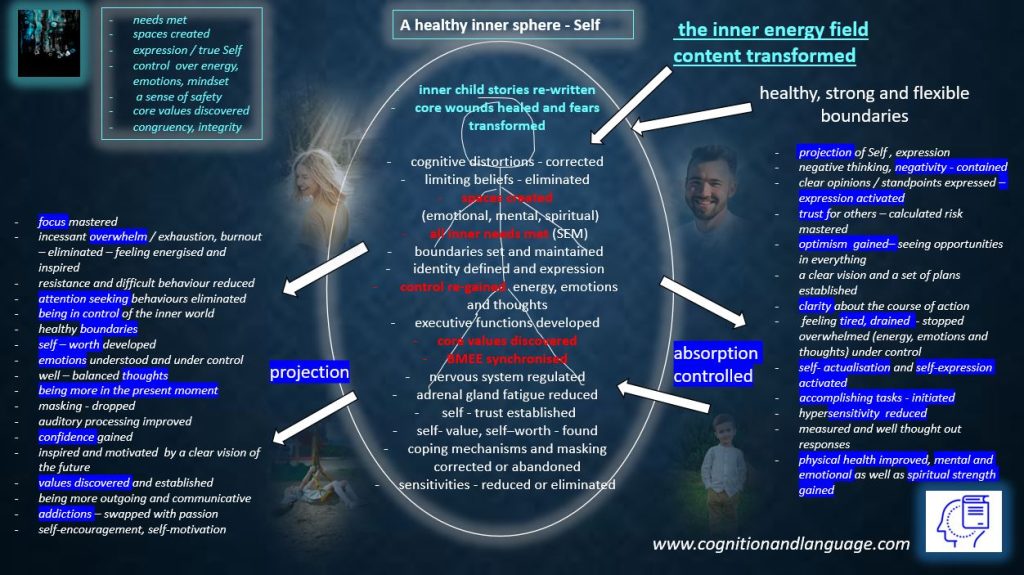
How will you benefit from the programme?
You will understand inner child syndrome and why you feel the way you feel.
You will recognise thinking patterns developed in your childhood and you will be able to correct these thinking patterns and replace them.
You will remove a harmful and limiting lens from your energy and your mind.
You will be able to recognise and control the inner child “filter” so it will not impact your well-being, your decisions and choices, your inner state and your conceptualisation of your inner self, your current circumstances and the vision of your future.
You will see many opportunities and possibilities that are outside of your current mindset – not yet processed by the mind.
You will become spiritually, emotionally and mentally much more mature.
You will be able to create your spiritual, emotional and mental spaces.
You will be able to transform your childhood experiences into growth, progress and awareness. You might even be able to help others.
You will understand others better and you will connect with others, equally mature people, on a much deeper level.
You will attract and manifest a different reality when you release the inner child’s energy.
TABLE OF CONTENT
Inner child syndrome
The programme on dealing with inner child syndrome can be divided into 7 main parts, as follows:
PART 1 – Inner child syndrome – where does it come from?
This part focuses on understanding the origins of inner child syndrome. It explores how experiences and memories are stored in our cells and how they impact our perceptions, feelings, decision-making processes, choices, and behaviours. It also highlights the role of childhood energy, emotions, and language in shaping our struggles in adulthood.
PART 2 – Symptoms and consequences of not dealing with your inner child
This part identifies the symptoms of inner child syndrome, the consequences of not dealing with childhood trauma and the unhealthy coping mechanisms that people use to deal with unwanted feelings, emotions, and thoughts.
PART 3 – PARENTS – our parents and inner child
This part examines how parents impact the development of our inner child, their conditioning, and their lack of skills to manage their energy, emotions, and mindsets. It also discusses how parents manipulate our feelings to control us and make us conform.
PART 4 – Stories we tell ourselves as children
This part explores the four main categories of stories that we tell ourselves as children: “I am not important,” “I am not worthy,” “I am not capable,” and “I am not good enough.” It includes a list of specific examples of language that manifest these subconscious beliefs.
PART 5 – How to deal with an inner child – how to transform it into energy suitable for an adult
This part presents strategies for dealing with inner child syndrome, including the 5A framework, expression, the five pillars of the inner sphere, spiritual, emotional, and mental spaces, boundaries, safety zones, trust, and communication with your inner child. It also discusses how inner child energy manifests in adult relationships and how to create safe spaces and validation.
PART 6 – How to deal with inner child syndrome
This part outlines necessary shifts in perception and other solutions for dealing with inner child syndrome.
PART 7 – Summary and step-by-step framework for dealing with inner child energy
This part provides a summary of the programme and a step-by-step framework for dealing with inner child energy, including a VID (Very Important Document) on changing inner stories and a list of harmful core beliefs developed in childhood.
They tell you to heal the inner child, but they don`t tell you how it is created and what causes it, or what is the source of the inner child – they know some causes, but they are not enough to explain the whole scope of issues that stem from inner child`s energy.
To heal your inner child, you have to know what caused it and what was the source of the energy, emotions and thinking. You need to see the link between your childhood memories, experiences and feelings and the way you feel now.
***
They tell you to express your inner child, but they don`t tell you about the materialisation process. It is necessary to process the energy first, the emotions and then the remaining stories that are still in our mindset. They also don`t have a solid framework or system to deal with that energy.
What people do not see properly is the process of materialisation: energy becomes feelings and emotions – they became bundles of energy, then they form a rather sophisticated network – that is why they trigger one another, and we experience feelings about feelings. These emotions turn into thoughts and then – language. These are the stories that were created without our participation! That is why they need to be corrected and rewritten! – this time, with our full attention.
***
They tell you it`s your inner child`s energy – you need to sort it out, grow out of it or something… but they don`t tell you exactly how and they don`t tell you about an alternative for replacement.
Rule number one: you don’t create and you don`t remove energy – you transform it. They don`t tell you how to transform your inner child’s energy into an adult one.
The energy cannot be destroyed or just removed – it can only be used to create something out of it that we want to experience or have.
We must have the new stories ready and in place while dealing with our inner child. The narrative must be changed swiftly and categorically.
***
They tell you to work on your inner child, to feel compassion… yes! … but they don`t tell you how to meet your inner child`s needs – they even don`t know what emotional, mental and spiritual needs are …!
If we want compassion and true healing – we have to meet ALL of our inner needs – spiritual, emotional and mental. It`s like expecting a plant to grow without giving it sunlight or water… – the needs for our energy are equally important or even more significant than physical needs in many different ways.
***
They tell you to heal the inner child in your and to get over it somehow…, but they don`t tell you how to create mental, emotional and spiritual spaces to do the healing!
Another condition for healing is to create a spiritual, emotional space where we can heal – where we can face our energy, emotions and our mindset. It is extremely important to have that space to deal with challenges that we may have and to increase your mental, emotional and spiritual capacity to simply cope with life…
***
They talk about the inner child, but they don`t talk about two types of challenges related to the issue: challenges that the syndrome causes, and challenges that may occur while you are dealing with it.
You must be aware of any emotional, spiritual and mental challenges – people are facing them every single day without realising what they are because they have been so intensely normalised…
The other type of challenges would be the ones we might stumble upon while dealing with our inner child – it might be a very difficult experience – facing your inner sphere and getting in touch with your inner child. Some say that the healing process is more painful than the wounds themselves.
***
They don`t tell you that simultaneously with the healing process, you also must increase your spiritual, mental and emotional capacities.
As we are healing the inner child inside of us – we must mature spiritually, emotionally and mentally. Maturity means growth, but also certain abilities and skills. We should master managing our inner sphere – read it, understand it, process it correctly and transform it into something we want to experience – the inner sphere as energy itself, as thoughts or emotions.
***
They tell you to get rid of the stories from your childhood, but they don`t tell you to transform your energy, learn how to process and control your emotions and how to be in charge of your cognition and your thinking patterns – your meta-programmes.
Without changes in all of these aspects, the change that will happen will be temporary, patchy and most likely, not permanent.
Changing your thinking is not enough – you must identify and correct any cognitive distortions, imbalances and inconsistencies. We must be aware of our thinking patterns – our meta-programmes and choose thinking which has the potential to give us better results and to serve us better.
***
They tell you to change your stories from your childhood, but they don’t tell you how to create a new identity, new energy, and new emotional and mental states. Also, you need to create solid, healthy, and flexible to some extent, boundaries.
As you are healing – you will develop a different identity: your energy will change, emotions and your stories will be different. Along with the new personality, you must also create solid, healthy and somewhat flexible boundaries.
***
They don`t tell you about the spaces to heal your inner child, they don`t tell you to shift your perception of your experiences first, see the growth, awareness, progress and contrast (ability to see things based on contrast – you cannot be or feel happy if you are happy all the time).
We suffer because the only way to experience happiness is suffering – the only way to experience satisfaction is to experience failure (re-direction). Everything exists based on contrast. We even die to experience eternity – not in our physical form – that`s for the soul.
***
They tell you to transform and alter your inner child`s emotions, memories and experiences, energy and mindset but they don`t tell you that you should transform your traumas into triumphs as a final part of the healing process.
Most people have been badly wounded during their childhood – emotionally, energetically and mentally. These wounds are capable of producing remarkable individuals, and you should become extraordinary yourself by using the wisdom, growth and awareness that are attached to these wounds. Not many people are capable of seeing them. The final part of healing should be about that – transforming pain into progress, trauma into triumph and wounds into wins.
***
They tell you about your thinking and limiting beliefs, but they don`t tell you about the three core conceptualisations: conceptualisation of Self, your conceptualisation of the world and your current situation, and finally, the vision of your future.
The inner child syndrome impacts our perception as the energy and emotions and thoughts included in it, function as a filter, like a thick lens that we see ourselves, our world and our future through – it must be corrected and replaced with more supportive conceptualisations.
***
They want you to stop being an inner child inside, but they don`t teach you how to upgrade your cognition regularly.
Without constantly updating and upgrading our conceptualisations, we will be stuck in the past, we won`t see the changes and the new circumstances, opportunities and possibilities they bring!
As we increase our inner capacity and we grow inside – spiritually, mentally and emotionally we obviously become more aware – self-aware and we resonate with our surroundings to a much higher degree. We also become a lot more observant. It requires constant upgrading and updating of our cognition – our conceptualisations. It includes observation of our thoughts, our emotions and our energy. We must watch them, examine them when necessary and replace them with more functional, supportive ones.
***
They tell you about the symptoms of a triggered inner child, but they don’t understand well enough what triggers your inner child and the true cause of that trigger! They don`t tell you about anything effective enough to do, think, feel or do when you are triggered.
How do you use the programme?
It`s very simple:

1.
Listen to audio recordings, access and read information files.
2.
Answer the questions in transformation files – one small section at a time.
3.
Track and assess your progress in progression files.



The programme is instantly available on all types of devices:
All you need is to listen, think, answer the question and change your perception.
You can listen to the programme on your phone, your PC, laptop or on your tablet.
You will be able to download the workbook and answer all of the questions there.
SUPPORT:
You will be invited to join a private Facebook Group where you will be supported by a community of people who struggle with similar issues. You will be able to ask questions, there will be Q&A, AMA sessions, laser coaching sessions and additional training sessions.
AUDIO RECORDINGS
In the recording below, I talk about inner child syndrome. It is the first part of the set of audio recordings included in the programme.
This recording will give you a much deeper understanding of the inner child, and how it comes about and it should give you a few solid ideas on how to deal with the issue.
Everyone has been a newborn, an infant, a toddler and a child. The two questions here are… – did you deal with the inner child`s energy properly, and if you didn`t – how much does it impact you as an adult?
DOCUMENTS AND FILES:
When you purchase the programme, you will gain immediate access to all of the documents in the screenshots below.
These documents are LIVE. They can be updated at any time.
You will have access to any ADDITIONAL documents that will be added to the programme in the future and UPDATED versions of the documents. You will be informed about any additions or updates to the files.
There are FOUR sections of the programme:
Information files
Assessment files
Transformation files (worksheets and workbooks)
Progression and results files

Programmes files are accessible on all devices.
Read and listen to programme files whenever and wherever you want to.
Google documents you will access immediately when you purchase the programme:
The Inner Child Syndrome Healing Programme – files
INFORMATION FILES
ASSESSMENT
Assessment and symptoms
TRANSFORMATION FILES:
STRATEGIES AND FRAMEWORKS
PROGRESSION AND RESULTS FILES
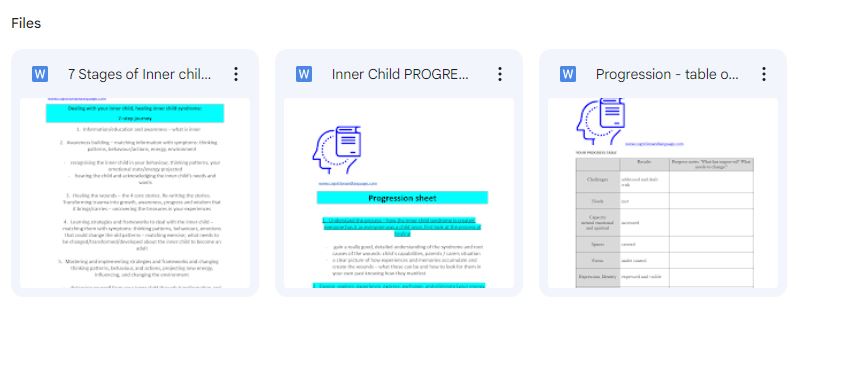
Here is why you should join the programme.
The programme will help you to:
Identify, describe, process and release the inner child energy from your current energy field.
Transform your inner child’s energy into your progress, awareness, and growth.
Create your spiritual, emotional and mental spaces and set healthy boundaries around them.
Leave your safety zone and discover possibilities you did not know you had, and see opportunities you did not know existed.
Become authentic Self and find validation inside yourself – not outside.
Have better relationships – heal the inner child in you and be stronger, more confident and resilient in these difficult times.
****************************
~ See the world through your future Self, not the lens of the inner child in you. ~
******************************************






The Inner Child Syndrome Healing Programme – BETA VERSION
Live sessions: support, coaching and mentoring will commence in March 2025. Includes recap sessions + Journaling
Regular weekly support sessions will be provided to participants throughout the programme.
Enrolment for the programme is now open. Early enrolment is strongly encouraged to maximise the programme’s benefits.
The sooner you start, the sooner you will become @strongerandhappierinside (YouTube Channel handle)
Become a Founder Member !
Be part of something extraordinary. As a founder member, you’ll enjoy:
Exclusive support: Personalised guidance and attention.
Shape the future: Influence the program’s development.
Early access: Be among the first to experience results.
Special privileges: Enjoy exclusive offers and perks.
Accelerated progress: Make rapid strides in your personal journey.
“Start Your Journey Towards a Healthier, Happier, and Stronger You Today—Join Us Now!”
Release the inner child energy that’s holding you back.
Transform that energy into growth, awareness, and resilience.
Create healthier boundaries for your spiritual, emotional, and mental well-being.
Explore new opportunities beyond your comfort zone.
Discover your authentic Self and find inner validation.
Build stronger, more meaningful relationships.
Ready to transform your life? Join the Program Now and start your journey today!
About the author:
Hi, My name is Isabella Aqif.
a.k.a. Her Majesty, Her Cognitive Highness – The Cognition Queen
I transform inner pain into outer power through cognitive, emotional and spiritual healing and transformation. I
help people heal their wounds, nurture their identity and live in authenticity with my inner child healing programme.
I am a cognition and language specialist, cognition and mindset coach and emotional and mental well-being mentor. I help people understand how their cognition and emotions work together to influence their thoughts, habits, behaviours, and overall well-being.
I combine evidence-based therapies such as CBT, and NLP with cognitive linguistics and applied spirituality in a holistic approach to the human inner world. I implement that through delivering cognitive, emotional, and spiritual transformation.
I believe that by understanding how our energy, brain, and emotions work, we can better understand and significantly improve our internal state and the quality of our lives.
I empower people to think more positively, improve their critical thinking skills, master their communication and solve problems more efficiently through cognitive mastery.
I serve parents, tutors, teachers, educators, professionals, and leaders by providing individual and group mentoring, as well as by offering workshops, training sessions, and unique personal development programmes.
If you are interested in learning more about how I can help you,
please contact me directly via e-mail or the contact form at the bottom of the page.
FREQUENTLY ASKED QUESTIONS
FAQs
Here are some of the most frequently asked questions about inner child syndrome.
- What is inner child healing?
Inner child healing is a process of reparenting your inner child, the wounded part of you that was hurt or neglected in childhood. It involves identifying and understanding your inner child’s needs, and then providing them with the love, support, and care they never received.
Inner child healing includes:
– healing four core wounds developed during childhood
– changing conceptualisation and approach to fear
– synchronising energy with your body, mind and emotions – creating congruency (BMEE synchronisation)
– meeting all emotional, spiritual and intellectual needs
– creating necessary inner spaces and using them correctly and effectively (that includes setting healthy, strong but flexible boundaries, expression)
– discovering your core values
Inner child healing is essentially a process of creating an alternative inner sphere and balancing your inner world with it. It is about the discovery what aligns with you, discovery of your inner energy content, finding out what works and what doesn`t work for you.
It is about creating spaces for expression and dealing with the energy in general, meeting you internal needs and looking after your energy, emotional state and your mindset.
Your suffering is never in vain – it produced a masterpiece: you.
- Why is inner child healing important?
Inner child healing can help you to:
* Heal from past traumas and emotional wounds.
* Improve your self-esteem and self-worth.
* Develop healthier relationships.
* Reduce stress and anxiety.
* Increase your sense of peace and well-being.
Inner Child Syndrome causes a lot of unnecessary emotional, spiritual and mental suffering.
People who suffer from the syndrome are a magnet to emotional, mental or even physical abuse due to a lack of expression, lack of spaces and boundaries.
People with ICS are prone to financial hardship as the lack of confidence might be causing them not to apply for better paid jobs or ask for a pay rise.
Individuals with ICS have difficulty in forming healthy relationships, whether it is at home, withing family, friendships or professional relationships at work.
- How do I know if I need inner child healing?
If you are struggling with any of the following, you may benefit from inner child healing:
* Low self-esteem
* Anxiety
* Depression
* Relationship problems
* Substance abuse
* Eating disorders
* Physical health problems
* A feeling of emptiness or sadness
* A sense of being stuck in life
* A sense of being trapped
People with ICS experience:
– incessant overwhelm – they are in permanent state of alert – the fear makes them feal unsafe and their brain is forced into fight or flight mode
– feeling of not being good enough, a sense that they are broken or there is something fundamentally wrong with them
– continuous, negative and limiting inner voice – not allowing them to put themselves first, not to take risks, not to leave their comfort zone, not to EXPRESS their feelings and thoughts, develop their identity
– masking, dissociation, resistance, a range of sensitivities, hypervigilance
– HSP, Empathy, ADHD, CPTSD symptoms
People with ICS experience being ignored and feeling invisible due to absence of emotional, spiritual and mental spaces with boundaries.
IMPORTANT: Inner Child Syndrome is not classified as a medical condition.
If you have been diagnosed with any medical condition and you are currently undergoing medical treatment, you may use available programmes as complementary. Please consult with your therapist, doctor or any other relevant healthcare professional about starting your healing process if you have any concerns or questions.
Traditional approaches to Inner Child Syndrome or mental conditions do not include processes embedded in the ICS healing programme but may be beneficial and may facilitate recovery. Please consult with your current medical care provider or any relevant healthcare professional if you have any questions or concerns around your symptoms or embarking on a healing journey.
- What is involved in inner child healing?
Inner child healing can be done through therapy, journaling, art therapy, or other forms of self-exploration. The specific process will vary depending on your individual needs and preferences. However, some common aspects of inner child healing include:
* Identifying your inner child’s needs
* Providing your inner child with the love, support, and care they never received
* Learning to forgive yourself and others for past hurts
* Learning to accept and love yourself for who you are
* Developing a sense of inner peace and well-being
– healing wounds – rewriting inner child stories that have been created in childhood
– re-conceptualising fear and changing approach to fear
– destroying boundaries made out of fear and replacing them with ones that are aligned with our need to grow and evolve rather than ones that made us shrink and protected us as children
– creating internal spaces: emotional, spiritual and intellectual
– meeting all inner needs
– discovering values
– synchronising energy with emotions, body and the mind
- How long does inner child healing take?
The amount of time it takes to heal your inner child will vary depending on the severity of your trauma and your commitment to the process.
Healing takes time but doesn’t have to take a lifetime.
The speed with which you heal depends on how much you work on your inner sphere.
There are four core wounds – you need to change stories they produce.
There are five types of fear – you need to address these fears
There are values to be discovered.
There is value to be discovered and validation received and provided.
There are spaces to be created. That includes boundaries.
There are needs to be met.
There are cognitive distortions and limiting beliefs to be addressed. If you address 20 of them correctly, you will most likely change your mindset.
You need to develop executive functions – manage your energy, control your emotions and master your mindset – this happens simultaneously with the processes mentioned above.
Depending on the amount of time spent on these processes you can make progress very quickly indeed. If you work every day or even every other day for an hour or two – it should take a few months (5-6 months) for a profound change to take place, for a significant shift to happen. If you add meditation, exercise and nutritious food, perhaps some vitamins and minerals that facilitate the processes, you will progress quickly.
The programme includes progression files so you will be able to measure and track you progress as you move through different phases of healing (there are 18 steps and 7 stages of healing)
- What are the benefits of inner child healing?
The benefits of inner child healing are many and varied. Some of the most common benefits include:
* Improved self-esteem
* Increased self-worth
* Improved relationships
* Reduced stress and anxiety
* Increased sense of peace and well-being
You will feel liberated and no longer trapped.
Your confidence and self-worth will increase exponentially.
You will create your spaces and you will express your Self with confidence and authenticity.
You will discover your values and what is important to you. You will, most likely, connect with your core inner being and your purpose.
You will feel satisfied and content internally as you will meet all you emotional, spiritual and mental needs.
You will feel grounded and you in your power.
You will learn how to manage your energy, control your emotions and feelings and how to master your mindset. You will develop executive functions and be able to create inner state that you desire.
You will no longer be a magnet for emotional or mental abuse, you will no longer be invisible and ignored by most as you will set boundaries and ne no longer limited by a safety zone.
- Will I have to face uncomfortable emotions?
In one word: no
You will not have to deal with your emotions and “sit with them”. You have been dealing with them all the time so far.
However, it might be necessary for you to describe the feelings and emotions which, of course includes identifying them and perhaps looking at them – it can be done from a perspective at first which should not be problematic. You will focus on the messages, growth, progress, awareness and wisdom they bring rather than feeling them – a completely different approach which will produce different results.
The first step is to create spaces to balance the existing wounds as they dominate the inner sphere. That includes a substantial, positive input and rewriting completely the stories created by these wounds. This is based on dichotomy and the belief that if you can think negative – you can think positive. It is critical for the positive to be based on solid foundation so it can withstand any negativity that may resurface.
- What are the risks of inner child healing?
The risks of inner child healing are generally, very low.
It is important to remember is that the Inner Child Syndrome is not classified as a medical condition by any major institution.
There is a possibility of some temporary side effects, such as increased emotional pain, anxiety, or flashbacks. It is also important to work with a qualified therapist or other mental health professional to ensure that you are safe and supported during the process.
These side effect mentioned above can be averted or at least significantly mitigated by creating “anti- wounds” first. With spaces that are in direct opposition to core wounds it will be much easier to deal with the wounds and minimise their impact. The stronger and bigger these positive spaces are, the less room for wounds and their influence.

Two more questions ….
What are your guarantees?
What support do you provide?
Here, at Cognition and Language, we want you to grow.
We are committed to your success – your emotional, spiritual and cognitive transformation.
That is why we offer a triple guarantee and advanced support.

Guarantees:
- Money-Back Guarantee We are confident in the transformative power of our Inner Child Healing Programme. If you complete the programme, engage with the provided materials, and still feel that you haven’t made any progress or experienced positive changes, we offer a Money-Back Guarantee.
To be eligible, you must fulfil the following expectations:
- Complete all required programme worksheets and exercises for at least 4 weeks.
- Demonstrate that you have actively engaged with the programme.
- Request the refund with a proof or robust evidence of working with the programme.
This guarantee reflects our commitment to your personal growth and healing journey. We believe in the effectiveness of our programme, and this guarantee is our promise that you will see positive results.
- Results Guarantee Your progress matters to us, and we stand by our commitment to your transformation. If you find that you are not achieving the results you expected, we offer a Results Guarantee. This includes:
- A one-off emergency session
- Additional, highly personalised materials and mentoring tailored to your needs.
To utilise this guarantee, you must request it in advance through our designated Google form within our private Facebook group. We are dedicated to your success and will work with you to ensure you achieve your goals.
- Satisfaction Guarantee Your satisfaction is our priority. If, at any point during the programme, you find yourself dissatisfied, we are here to address your concerns. Our Satisfaction Guarantee includes:
- A catch-up session to discuss your reasons for dissatisfaction.
- Guidance and additional materials to enhance your experience.
- Email support for ongoing assistance.
For those who may find it challenging to attend Q&A sessions, we offer TWO general catch-up sessions during the 12 weeks, open to everyone. We are committed to ensuring your satisfaction and will work with you to resolve any issues.
Our guarantees listed above demonstrate our unwavering commitment to your personal growth and healing journey. We strongly believe in the effectiveness of our programme and are dedicated to helping you achieve positive changes in your life.
Support:
- Private Group Support Join our private Facebook group to access continuous support and guidance. This space is designed for you to ask questions, raise concerns, and connect with fellow participants. We will also compile questions in advance and publish answers in a dedicated section of the group. You will receive additional worksheets, videos, and files to enhance your learning and eliminate any doubts.
- Email Support We offer personalised email support for those with specific questions or concerns. Simply submit your inquiries through the provided Google form in the Facebook group, and we will respond promptly, either privately or within the group, based on your preference.
- Q&A and AMA Weekly Sessions Participate in our weekly Q&A sessions where you can ask questions ahead of time. We will analyse your questions and prepare comprehensive answers during the session. These sessions are an excellent opportunity to receive direct guidance and insights.
- Emergency Session Request In case of urgent need, we provide one emergency session during the 6-week programme. Please use our request form within the group to request this session. We reserve this for genuine emergencies and may offer alternative support for non-emergent concerns. Your inner well-being is our top priority.
We are here to support you every step of the way on your healing journey. Our commitment is to provide you with the tools, guidance, and assistance you need to succeed. Your growth and well-being are our primary focus, and we are excited to embark on this transformative journey with you.
What`s included in the Inner Child Healing programme?
The Inner Child Healing Programme Files (value: £497)
10 implementation sessions
– two sessions per week for twelve weeks (see the details below) (value: £3,970)
BONUS: An Ebook:
SEM – Spiritual, Emotional and Mental Well-being – a JOURNAL
– includes one implementation session with Q&A (value: £97)
BONUS SESSIONS:
The healing journey – a seven-step process to emotional, mental and spiritual well-being.
EMOTIONS – 10 things that we get wrong about emotions
ENERGY – what are the laws of the inner energy?
THE MINDSET – what you didn`t know about thoughts and your mind.
7 archetypes of an inner child – which one dominates in your inner child syndrome?
Value: (£3, 970)
Private Facebook Group – a friendly community and ongoing support – priceless
ANY additional worksheets, workbooks, audio files or presentation slides added to current documents in the future. – priceless
The Inner Child Syndrome Healing Programme
including 10 implementation sessions
and additional 7 STRATEGY SESSIONS!






10 implementation sessions
Foundations of Self-Understanding
Session 1: Challenges, Needs, Spaces, and Capacity
Exploring Inner Needs: Examine the mental, emotional, and spiritual challenges you face and identify the two sets of inner needs that drive your responses.
Building Resilience: Learn strategies to expand your inner capacity to better manage life’s challenges.
Creating Inner Space: Understand the role of inner space for self-reflection, growth, and emotional processing.
Session 2: Expression, Boundaries, and Identity
Crafting an Authentic Identity: Discover the foundations of identity formation and self-expression. Reflect on who you are and how to convey your true self.
Establishing Healthy Boundaries: Recognise and reframe fear-based and wound-based boundaries to support well-being. Learn how to develop flexible, empowering boundaries that foster self-growth.
Healing and Self-Mastery
Session 3: Inner Child Wounds and the Inner Voice
Unearthing Core Wounds: Delve into the deep-seated stories and wounds from your inner child that may shape your adult life.
Understanding Your Inner Voice: Explore where the inner voice originates, its purpose, and techniques to transform self-limiting narratives.
Session 4: Control and Mastery Over Emotions, Energy, and Thoughts
Differentiating Inner Experiences: Distinguish between energy, emotions, and thoughts, and understand why it’s essential to separate these.
Reading and Processing Inner Signals: Learn how to identify, interpret, and regulate your feelings, thoughts, and energy for a balanced internal state.
Inner Resources and Present-Moment Awareness
Session 5: Values, Providing Value, and Validation
Identifying Core Values: Clarify your core values and discover ways to align with them authentically.
Recognising Inner Resources and Superpowers: Tap into your unique inner strengths and develop them as resources for personal and interpersonal value.
Session 6: Presence and Focus
Overcoming Dissociation: Recognise dissociation and learn techniques to stay present in the moment.
Enhancing Focus: Understand the importance of sustained attention, learn how to manage distractions, and develop tools to strengthen focus over time.
Boundaries, Regulation, and Synchronisation
Session 7: Nervous System Regulation, Focus, and Fear-Based Boundaries
Managing Nervous System Responses: Explore methods for regulating your nervous system to handle stress and enhance focus.
Shifting and Strengthening Focus: Work on shifting focus from negativity to productive thinking, addressing focus challenges stemming from childhood experiences.
Session 8: Projection, Absorption, and Observation
Distinguishing Between Processes: Learn the difference between projection, absorption, and observation, and how each influences perception.
Achieving Internal Synchronisation: Align body, mind, emotions, and energy to achieve a balanced and congruent internal state.
Shifting Perspectives and Cultivating Discernment
Session 9: Cognition and Conceptualisation
Exploring Self-Concept and Reality: Understand how you conceptualise yourself, the world, and the future, recognising harmful conceptualisations and reframing them positively.
Shifting Perspectives on Key Life Issues: Reframe essential life concepts like failure, change, rejection, and loss to support resilience and growth.
Session 10: Discernment, Alignment, and Manifestation
Developing Discernment: Cultivate the ability to identify helpful energy, emotions, and thoughts, and distinguish supportive influences from potentially harmful ones.
Aligning Body, Mind, Emotions, and Energy: Synchronise your inner and outer experiences to foster clarity, alignment, and manifestation of your goals.
********************
The number of spots in the programme is limited
as I plan to work very closely with most participants and
support them in implementing the programme.
The Inner Child Healing Programme – …………………………………………………………………………….. value £497
10 implementation sessions (12 weeks, 2 / 3 sessions per week)
– two / three sessions per week for for twelve weeks (see the details below)………………………… value: £3,970
SEM – Spiritual, Emotional and Mental Well-being – a JOURNAL
– includes one implementation session with Q&A ……………………………………………………………. value: £97
Bonus training sessions:
EMOTIONS – 10 things that we get wrong about emotions
ENERGY – what are the laws of the inner energy?
MINDSET – what you didn`t know about thoughts and your mind
The journey of healing – a seven-step process to emotional, mental and spiritual well-being
7 archetypes of an inner child – which one dominates in your inner child syndrome?
Bonus sessions: ……….…………………………………………………………………. value: £3, 970
Q&A Sessions
Q&A sessions………………………………………………………………………… value: £3, 970
TOTAL VALUE: £12, 504
HALF PRICE!!!
was – £ 997
now £497
SAVE £500!
Don`t miss out! Buy it before the price goes up!
The spots in the programme are limited as I plan to work with participants individually.
Grab yours before it is too late, enrol now.




Comment Contact Contribute
Get in touch.

info@cognitionandlanguage.com
Thank you for getting in touch!
