

Who are consultations and sessions for?
Leaders, Managers, Entrepreneurs, Business Owners, Coaches, Teachers, Corporate Professionals
who are committed to personal development and would like to increase their capacity to cope with emotional, mental and spiritual challenges.
ALSO:
Empaths, HSPs, Hyper-sensitives, Neuro-divergent people
CPTSD / PTSD, ADHD / ADD
Anyone who suffers from:
People pleasing / Imposter Syndrome / Ostrich syndrome / Weak boundaries / Negative thinking and negativity
Procrastination / Expectations / Perfectionism / Fear and Worry
Fulfilment/ passion / Overwhelm / Stress / Anxiety / Performance anxiety
People who love personal development:
People who want to feel stronger and happier inside and:
heal inner child wounds
develop strong executive functions
confront their inner child`s fears
master focus and attention
deal with incessant overwhelm
reduce painful sensitivities
meet inner needs
eliminate any harmful coping mechanisms
feel more present and grounded

COGNISANT LEADERSHIP
Before you become a leader, you might want to increase your internal capabilities and…
understand the inner wounds and fears – their causes and functions
heal your own inner wounds and address any fears – if present
discover your values, master how you provide value, evaluate and validate
create your internal spaces: spiritual, emotional and mental spaces
express yourself fully
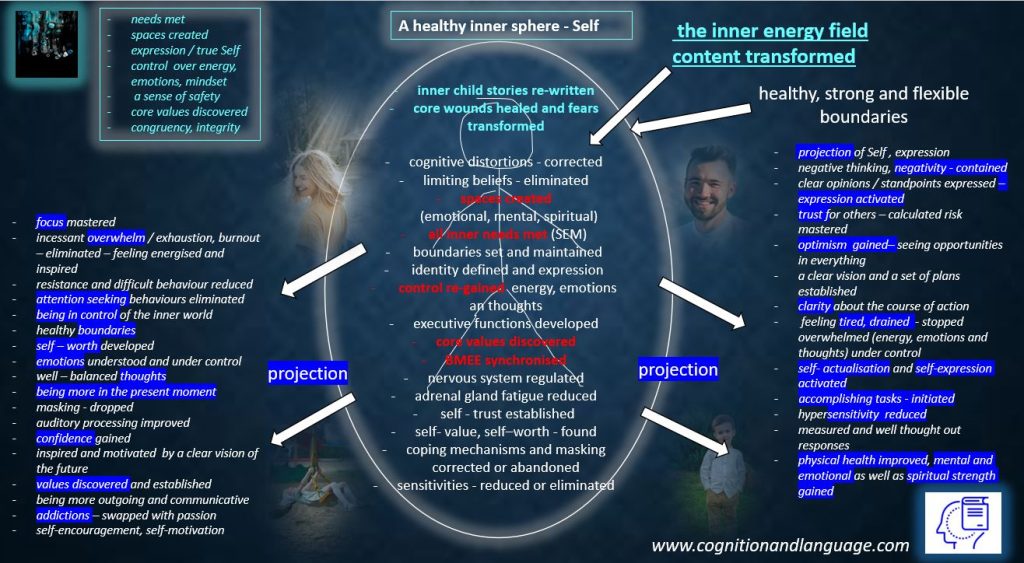
synchronise your energy with your body, emotions and your mind – BMEE synchronisation
meet your inner needs and create the right conditions as you create your spaces
start controlling your energy, emotions, and thoughts – develop and practise your executive functions
Ongoing processes:
value discovery – core values are dynamic and change frequently throughout the course of life
updating, and upgrading your cognition – your cognitive functions and skills
correcting your cognitive distortions, inconsistencies, imbalances and biases
meeting all of your inner needs: emotional, spiritual and intellectual
mastering control over your energy, emotions and your thoughts
creating the right conditions for your inner sphere to
expressing yourself authentically and updating and expanding your internal spaces
To lead others successfully, you may want to:
– understand the inner wounds, fears and sensitivities that come with them
– understand the issue of control and a sense of safety, having spaces, expression, values, BMEE synchronisation
– learn how to manage the energy of others, learn how to control the emotions and feelings of others, and learn how to read, understand and influence other mindsets
– master creating the right conditions for people to thrive – meet their inner needs – two sets of needs
– teach others how to access their inner resources and their inner superpowers – to inspire them, to make them more creative and productive, to increase the quality of their contribution
***
Before stepping into a leadership role, it’s important to develop a deep understanding of your own inner world. By exploring the roots of your inner wounds and fears, you can better understand how these elements may impact your leadership style and decision-making.
Once you’ve identified these issues, it’s important to take the time to heal your own inner wounds and address any fears that may be holding you back.
As you explore your inner world, it’s also essential to discover your core values and how you can provide value to others. By evaluating and validating your strengths, you can create a strong foundation for your leadership. In order to truly thrive as a leader, it’s important to create internal spaces for spiritual, emotional, and mental growth before you can grow others.
By expressing yourself authentically and synchronising your energy with your body, emotions, and mind through BMEE synchronisation, you can cultivate a sense of inner balance and well-being.
Creating the right conditions for your own personal growth is essential, as it allows you to meet your own needs and develop the executive functions necessary for strong leadership and makes you ready to meet other people`s emotional, mental and spiritual demands.
By mastering control over your energy, emotions, and thoughts, you can cultivate a sense of self-awareness and develop the tools necessary for successful leadership, and impact others by leading them with your strong, high-vibrational energy, your positive emotions and your strong mindset.
Ultimately, by focusing on your internal growth and development, you can create a strong foundation for effective and compassionate leadership and leave a very powerful, positive and lasting legacy.



Inner Child Syndrome at the Workplace
Send download link to:
50 ways Inner Child Syndrome Impacts Leadership
Send download link to:
Inner Child Syndrome and Leadership
Send download link to:

About the sessions
Each session set comes with a comprehensive inner sphere assessment to help you gain clarity on your strengths, weaknesses, and areas for improvement. Using this assessment, you will work with your coach to create a clear and bespoke plan of action for personal development as a conscious leader. This plan of action will be tailored specifically to your needs and objectives, ensuring that you are equipped with the tools and strategies necessary to succeed.
In addition to the inner sphere assessment and personalised plan of action, each session set also includes a range of personalised resources to support your growth and development as a conscious leader. These resources may include articles, videos, podcasts, and other materials that are specifically chosen to help you address your areas of focus and achieve your goals.
To help you implement the strategies and insights gained during each session, you will also receive worksheets that are designed to guide you through the process of personal growth and development. These worksheets will help you stay on track and monitor your progress, ensuring that you are making tangible strides towards becoming a more effective, conscious leader.
With each session set, you will also receive a comprehensive set of resources and support to help you unlock your full potential and achieve your goals as a conscious leader.

1:1 sessions
What exactly can be accomplished?
– Possible session topics and goals of a session –
spiritual, emotional and mental well-being improved
– challenges faced and addressed
– internal needs met
– spaces created
– mental, emotional and spiritual capacity increased – control over energy, emotions and the mindset gained
expression, boundaries, and identity (fear-based boundaries) developed
– emotions – read, understood, processed and expressed or released
– boundaries – constructed and maintained
– fear-based boundaries – replaced
the inner child stories and core wounds – the inner voice + all sensitivities transformed
– inner voice – re-programmed / counterbalanced and replaced with more expression and created mental, emotional and spiritual spaces
– core wounds healed and stories re-written
a range of sensitivities – reduced or eliminated:
– wound-based sensitivities
– fear-based sensitivities
– RSD – rejection sensitivity disorder
– CSD – control sensitivity disorder
– DSD – demand sensitivity disorder
control and empowerment: introduction to energy, emotions and the mindset (cognition) control over energy, emotions and the mindset – initiated and practised
– the distinction between emotions, energy and thoughts mastered
– a foundation for managing energy, controlling thoughts and mastering the mindset – established
– the ability to control inner energy, emotions and thoughts – practised and developed
values, providing value and validation – defined
– core inner values discovered
– potential value that can be delivered – identified
– value – delivered
– validation given and received (multi-levelled validation: spiritual, emotional, mental, social, physical, financial)
introduction to inner resources and superpowers
– awareness of inner resources and inner superpowers – initiated
– learning about available inner resources and inner superpowers and beginning to address them
dissociation – being present in a moment – mastered
managing focus – practised
– dissociation awareness and management- developed
– focus managing and shifting – developed and practised
– fear-based boundaries – established
– nervous system regulation exercises – practised, overwhelm-reduced
– awareness of the attention developed – coming out of the safety zone and negativity trap
– focus on negativity – minimised
– fear re-defined, a new conceptualisation of fear – adapted and used
– the ability to regulate the nervous system developed and practised, maintaining focus and focusing on positivity – initiated and practised
projection, absorption, observation/manifestation – differentiated
– the distinction between three different processes – developed
– introduction to body, mind, emotions and energy synchronisation – initiated
– projection of energy and the law of attraction – awareness established
– practising observation and absorption of energy and emotions – initiated
conceptualisations
– two types of conceptualisations:
3D – Self, the world (your reality) and the future, a set of life-defining conceptualisations
– conceptualisation of failure, change and the unknown, problems and challenges, rejection, loss and lack – altered
– new conceptualisations created and utilised: health, money, work, relationships – re-defined and transformed (into a more supportive and helpful one)
discernment and disconnection (energy, emotions, the mindset) – alignment and manifestation – criteria for discernment – developed
– BMEE synchronisation – achieved
– discernment and awareness – created
– the inner energy synchronised with emotions, thoughts and the body – accomplished
Leadership at its finest:
Leading with your energy, emotions and your mindset.
Understand how to influence other people`s energy, emotions and thoughts.
Become a thought leader with a powerful, clear vision, develop great resourcefulness, inner strenghth and resilience.

EXCLUSIVE
1:1 Sessions
6 sessions or 12 sessions
You can purchase a set of 6 or 12 sessions- whichever suits you better!
only £ 397 per session!
What you will get with each session set:
– your inner sphere assessment
–clear, bespoke plan of action for personal development as a conscious leader
– personalised resources
– worksheets
What would you like support with?
Your 1:1 sessions:
1 : 1 Conscious Leadership Coaching Sessions
If you have any questions, please fill out the form below and let me know how I can help you.
Comment Contact Contribute
Get in touch.

info@cognitionandlanguage.com
Thank you for getting in touch!
COGNISANT LEADERSHIP
- the necessity to safeguard the health of the workforce and communities is now obvious and in plain sight
- well-being is a top priority for companies and leaders more profoundly than ever before
- there can’t be productivity if people aren’t well, but this has also certainly extended to family members recently
- supporting employees in every way possible – mentally, emotionally, financially, socially and spiritually is the fastest way to prosperity in all shapes and forms
- increased leaders’ awareness that they and their teams need time and support to take care of themselves and their loved ones
How to look after the team members` mental and emotional well-being.
How to create core conditions for people to thrive in.
How do we support employees mentally, emotionally, financially and spiritually?
The great U-turn: how does the job serve people – not how people can be used for the benefit of the company, institution or the system as a whole?
Understand the mindset, emotions and energy to positively influence people.
Meet employees’ needs and create core conditions for them to thrive.
Empower employees and encourage them to use their inner resources and their inner powers to create more and better quality and to be more inspired.
- growing economic uncertainties and cost of living crisis are currently intense
- ressession seems imminent
- people look for stability at work
- employees will want to work for companies that have an essential qualities: trust + safety
- culture and leadership that people can trust is fast becoming a differentiator
- trust in leadership and societal institutions is at an all-time low right now
- trust is something more companies are designing for as part of their leadership development programmes
- without trust there is a sense of lack – people will not buy, they won`t be generous, benevolent
- leaders will continue to be central in building trust and securing employees` loyalty for the foreseeable future
How do you develop and maintain trust?
How do you develop credibility?
How do you lead in challenging times?
How do you deal with the change and the fear of the unknown?
- the great shake-up for leadership skills is happening right now
- traditional leader skillsets including communication which could once be mastered, now need to be refreshed and virtual contexts added
- leaders will continually need to refresh and develop skills – including internal abilities: mental and emotional abilities to cope with challenges
- soft skills
- trainability, flexibility and internal qualities gaining importance in the process of hiring
- empathy, connection and relationships are prioritised over transactions, deals
- there is an increasing need to expand mental, emotional and spiritual abilities to lead better
How do you develop soft skills in leadership?
How do you develop the empathy needed in leadership?
How do you lead in virtual/hybrid environments?
How do you improve your ability to cope with challenges? How do you increase your mental, emotional and spiritual capacities to cope with challenges better?
- employee`s experience surged to the top, hot topics around the workplace
- both years: 2021 and 2022 were key learning years for employees and employers
- professionals developed high expectations in terms of how and where and how much they can work
- huge increase in work flexibility and alternate modes of employment have contributed to the fluidity of the workforce and increased the pace of turnover which now is being addressed
- there’s an increasing desire for skill and career development that companies cannot afford to ignore – the ability to face challenges and changes, mental, emotional and spiritual agility, resilience and a clear alignment with who we truly are
- it will be more important for top talent to not only feel valued but be aware of their growth potential for the future: validation = improved retention growth = better results
How do you create optimal conditions for your team members?
How do you make your people thrive?
How do you meet your employees’ emotional, mental and spiritual needs?
How do you develop your people?
How do you grow new leaders?
How do you celebrate, acknowledge and validate your people? – multi-levelled validation.
- the importance of embracing diversity, equity, and inclusion has never been more prominent
- unleashing the potential of your employees – creating a growth container is becoming a trend
- creating a better and more engaged workforce that leads to more profitability
- where there is greater representation, there is greater performance and more revenue
- leadership increases its focus on diversity, there are benefits to retention. recruiting, profits, and better performance, in particular
How do you engage employees?
How do you inspire and motivate your team members?
How do you involve and include your people?
How do you include, involve and engage different people with distinct energies, emotions and mindsets?
How do you collaborate with others and how do you facilitate collaboration between different mindsets, emotional beings and spirits/energies?
Future–based leadership.
Emotionally agile leadership – how to manage and lead with feelings and emotions
- the frequency of burnout in a business is based on factors that are directly linked to leadership style
- constantly changing or unclear instructions, an unrealistic workload, and low emotional reserves (emotional capacity)
- burnout has been even more abundantly present since the COVID-19 pandemic: 40 % increase for those working in an office and 41 % for those working remotely before abruptly crashing
- employee well-being and engagement: engagement decreases burnout, with an increase in productivity and well-being, but when engagement and well-being decrease, burnout increases
- empathy and emotionally agile leadership is the key to success
- instructions have to be clear and if not – clarifying them
- keeping in touch with both: remote and in-person workers to ensure that the workload is realistic and not overburdening
- checking in on the emotions of employees and making sure that their mental health isn’t suffering
- leaders can prevent burnout in their teams, and they must
- there is an increased emphasis on mental health and employees are noticing the trend
- many people are weighing up their personal health needs against their current role requirements and choosing resignation over allowing their job to interfere with or damage their mental health (health before wealth because your health IS your wealth)
- it is imperative that employers care about, prioritise, and address the mental health needs of their employees – not only mental but emotional and spiritual needs too
How do you identify and describe your energy and your emotions?
How do you read, understand and process your emotions?
How do you recognise maladaptive mechanisms used by people to cope with their feelings and emotions?
How do you determine possible functions and messages carried by emotions?
How do you cope with emotions of the other people?
- baby boomers, Generation X, Generation Z, and millennials are all working side by side in a multigenerational workforce
- different values and working styles are likely to collide
- senior employees can easily be a few decades older than a company’s youngest workers
- the need for leaders who can adjust their leadership style according to who they’re managing
- each generation comes with its own cultural context and economic background, and so requires different leadership skills
- a multigenerational workforce has a great opportunity to learn from one another and foster a culture of collaboration, teaching, and understanding
- leaders need to be more flexible, accommodating and equipped with skills to tackle the differences and potential conflicts of interest in a multigenerational team
How do you understand other people – mentally, emotionally and spiritually? How well do you read other people?
How do you deal with and resolve conflict in your team?
How do you manage people`s energy, emotions and mindsets?
How do you set up an environment of learning, collaboration and understanding?
The difference between male and female leadership styles.
Current leadership practices are too masculine and out of balance.
Feminine vs masculine styles of leadership and how to keep them both in balance.
- authenticity in leadership is the key to success
- leaders who create space for thoughtful, honest conversations about real issues that impact their team will thrive now and well into the future
- organisations are investing in leadership development skills to teach leaders to function in an authentic way as it creates more trust
- the workplace can and must be improved through authenticity in management and leadership
- authenticity also improves employees` productivity, creativity, trust between employees and leaders, relationships between co-workers, and produces positivity in the work environment
- authenticity starts at the top, with leadership that communicates effectively and provides constructive, honest feedback with an opportunity to practise and master a required set of skills
How do you become authentic as a leader?
What does being authentic mean?
What is the foundation of authenticity?
How do you encourage authenticity in others?
- leaders need to stay responsive and adaptable
- leaders should adopt a flexible way of thinking and think beyond their usual way of thinking – think outside of the box
- different perspectives that can offer different insights, by sharing their knowledge, employees can help their teams find solutions and grow
- trust and respect are important for team members to feel psychologically safe and supported
- there is also mental safety, emotional safety, social and financial safety
- building relationships with others and offering a safe place for opinions and risks where employees are able to communicate and build upon ideas, work through hardships, and support one another to get desired outcomes
- one part of being an adaptable leader is adapting your leadership style to different contexts and situations – having different ways of thinking and acting for different occasions
- the most effective leaders adapt their leadership style to different contexts and situations really well and fast
How do you stay on top and up to date?
How do you adapt to the new environment?
How do you introduce /communicate change?
How do you navigate through changes?
Cognisance as a key to staying relevant and up to date.
A growth mindset as a key to constant improvement.
How do you become flexible?
- shared ideas and values influence how your employees think and behave
- developing a healthy culture where teams feel safe, comfortable, valued, and supported is critical in any workplace today
- having the right improves employee engagement, retention, performance, and innovation, as well as overall business profitability
- working on company culture has been proven to have a measurable, tangible impact
- more people are working remotely, company culture has changed immensely and there is an increasing demand to adapt
- by establishing core company values and goals, while including, involving and engaging every single person in a team, the desired culture can be created
- showing appreciation, asking team members what they want and need, offering support, and asking for feedback goes a long way in growing a company`s specific culture
- letting the company mission and vision lead culture is the first step toward ensuring a remote or hybrid culture that is well established and maintained
How do you ensure core conditions for your team members?
How do you communicate your vision and your mission?
How do you include, involve and engage your team members?
How do you align your values and your priorities with how you feel, what you say and what you do as a leader and how do you keep your team accountable for what they say and how they act?
Conflict
- workplace conflict can happen for many different reasons
- disagreements about work procedures, different or unmet needs, interests or ideas of employees and basic personality clashes
- It is helpful for leaders to acknowledge the impact of workplace conflict and know how to resolve it quickly and effectively
- leaders can build consensus among your employees to save valuable time and lead to improved cooperation, enhanced productivity, increased employee motivation and greater employee retention
- conflicts are an opportunity for growth and change and should be used to generate improvement
How do you resolve conflicts among the team?
How do ensure that your employees are heard, acknowledged and validated?
How do you set boundaries in a conflict of interest?
The inability to see the third way, ego and the needs of the employees are the most likely foundations of a conflict.
How to use conflicts to grow your team
Coping and dealing with change
- a competent leader is vital in helping employees cope with change by understanding what drives it and the uncertainty that surrounds it
- it is critical to know the different ways in which people respond to change
- how to use change to learn a different, more effective and productive way of doing things
- focusing on challenges brought on by change – addressing them and learning from them
- acknowledging the importance of resilience, opportunities presented by a change and understanding steps to use change positively by evaluating it and applying new processes or ideas for success
How do you cope with change?
How do you communicate change?
How do you adapt to change?
How do you deal with the fear of the unknown?
Problem-solving skills
- problems are inevitable
- developing problem-solving skills is extremely helpful for leaders to learn how to identify problems as they arise
- identifying effective solutions, studying different methods for problem-solving can help leaders prevent or approach difficult situations in a positive, relevant and successful manner
How do you solve problems?
How do you look for solutions?
How do access your inner resources and superpowers to solve problems?
What questions do you ask? Do your questions produce answers and solutions?
How to utilise a problem to create new solutions.
Virtual leadership – how to lead virtually?
- virtual leadership training can help you acquire the skills needed to lead your digital team to success
- as a leader, you need to be effective in communicating without face-to-face interaction
- development of high emotional intelligence to steer team empowerment, culture, collaboration and engagement – even in a virtual setting
- maximising your online tools while perfecting your technical skills to use the tools efficiently is a must today
How do you manage a virtual team?
How do you assess the well-being of your team members remotely?
How do you meet your employees’ needs in a virtual setting?
How do you use your energy, your emotions and your linguistic abilities in the virtual world? How do you read between the lines?
Building trust and respect and credibility as a leader?
- employees need to trust and respect the management team and leaders as individuals
- as a leader you need to build a foundation of trust with your employees
- employees are more likely to respect the decisions you make for the company and the strategies you plan to implement to move the team toward success if they trust you and respect you
- you can learn to build trust, credibility and respect with your employees by acquiring training and skills in effective communication
- striving to be transparent and consistent, and discovering the best ways to encourage confidence in your employees so they also feel motivated to openly share input or provide you with their feedback
How do you build trust in a team? How do you ensure your team trust you and they trust one another.
The core conditions for building trust in a team.
The core foundation of trust in a workplace.
Coaching to improve employees` performance and creativity – the quantity and quality of contribution
- coaching in the workplace leads to improved employee performance
- coaching helps each team member feel recognised and valued
- coaching is a skill that allows leaders to develop more effective and meaningful working relationships with their employees by:
asking them a set of guiding questions
giving them compliments
listening to and empowering them by encouraging honest communication and understanding their perspectives
showing commitment to their continued growth and development
How do you coach your team?
The five pillars of the inner sphere: energy, emotions, mindset, needs and resources.
The 6 E of the inner sphere.
Creating core conditions and meeting your team`s needs.
Current practices.
Managing effective meetings
- meetings should be a very important part of a business because they are an excellent way to communicate changes, concerns or ideas and to give and receive feedback
- planning and using meetings effectively can benefit a business’s productivity, focus and efficiency by using time wisely to accomplish necessary goals
- training leaders on ways to keep meetings timely, schedule them sparingly, prepare for them purposefully, manage them appropriately and encourage those involved to take part meaningfully, can help your company conduct more successful and effective meetings
Energy, emotions and the mindsets in a meeting – how to control them and transform them into positive ones?
How to maintain focus and what to focus on in the first place.
Aligning meeting goals with necessity, urgency and relevancy.
Motivating and encouraging employees
- motivation is key to employee performance and company success
- management can help motivate and encourage their employees by understanding the nature or concept of motivation and how it relates to and impacts the workplace environment and employee`s well-being.
- learning motivational techniques and how and when to use them to encourage employees to reach their highest potential is essential for effective leadership
- the best leaders distinguish between motivation and inspiration
How do you inspire and motivate your team?
How do you inspire your team?
How do you use energy, emotions, and mindset to inspire others?
How do you use values, priorities and other people`s interests to motivate them?
Effective communication skills
- how you communicate with your employees drives the type of working relationship you have with them
- cultivate a positive and cooperative bond – develop and nourish connections
- it’s important to learn how to be a good communicator
- communication skills training can help you overcome common barriers to effective communication with your employees
- provide clear, direct and motivating statements, give constructive feedback, regularly converse with your team and listen to their needs and input
How do you communicate effectively?
How do you use language that will be understood by all and offends none?
Communicating and packaging your message in the right way.
Creating the right metal, emotional and spiritual environment for effective communication process to take place.
Time and energy management
- time management is crucial to working more efficiently and productively
- training management to capitalise on time as an asset by clearly defining goals and prioritising appropriately, delegating resourcefully, minimising interruptions and maximising prime working hours
- leadership should enhance workplace production and morale
- when leaders learn how to invest in their employees’ energy (e.g., encouraging breaks and lunch hours, and discouraging long workdays as a continuing practice), they are better able to harness their employees’ time, they will enable employees to manage their time more effectively
- when employees are less stressed, more energised and ready to work, you can better motivate them to work through projects and deadlines on time with fewer mistakes
- time IS focus – how you manage your focus is how you manage your time
How do manage your time – your focus?
How do you manage your energy – your emotions?
How do you manage your energy and emotions using language?
Energy, time management and realistic targets.