

~ Language and cognition improvement~
Mentally tortured? Keep thinking negatively? Overthinking? Not seeing it? Feeling hopeless and helpless?
– control your mind and improve your cognition
Understand the three layers of your cognition and how they impact you, your inner sphere and your team; manage and control your language and cognition, empower others to correct their limiting beliefs, negative thinking and overthinking.
Cognitive distortions, imbalances and inconsistencies:
– recognise them and correct them
Meta – programmes management:
– understand and connect to others like never before – positively influence and empower them
Your language and Cognition
– Did you know that we have three distinct levels of cognition?
– Do you have/experience any of the cognitive distortions?
– Do you utilise your metacognitive functions?
– Are there any imbalances or inconsistencies in your cognition?
– How does the language you use influence your inner sphere?
– How do your thoughts impact your inner sphere?
– What kind of mental space do you live in?
– What concepts that you have should be cognitively altered/improved?
– How is your conceptual system structured?
– Do you update your cognitive system regularly?
– How well do you ‘verbalise’ / use language to express what`s in your inner sphere?
– How does language change your inner sphere into your outer reality? (language as a tool and a link between your thoughts and matter)
– How much of your conceptual system (your mindset) is a copy; how much of it is your choice?
– Did you know that language as a communication tool is not … words/sentences or longer texts?
– Did you know that language is a very powerful connector to other people through mirror neurons?
–Did you know that language is the key to empathy?
– Language you use is a reflection (a set of symptoms) of what happens in your inner sphere.
– Did you know that language is energy? Did you know that certain language and certain cognitive meta functions as energy blocks? (limiting beliefs, cognitive distortions or negative emotions)
– If your life depended on the language you use, what would you say?
– What language do you use around the most important aspects of your life?
– What language, what cognition do you use or have around your most pressing issue?
When you mismanage your mindset:
– you will use harmful and hurtful vocabulary and phrases – without even knowing it
– you will have a large number of cognitive distortions, imbalances and inconsistencies
– you will have many negative thoughts
– you will experience mental torture in a form of fear and worry
– you won’t be aware of your own cognition your cognition will be unmanaged and out of balance or control– (meta-programmes will run as conditioned)
– you will be cognitively biased
– you will have an uncontrollable mind and you won`t be able to control your thinking and your mind will control you
– you will have many mental blocks in a form of limiting beliefs
– you will use unhelpful and harmful defence mechanisms to deal with unwanted thoughts
– you will struggle with making decisions and taking even the smallest risk
– your mind will keep you in your safety zone
– you won’t be using a language as a tool to manage your whole energy or body
– you will have a large number of unsupportive, inaccurate conceptualisations
– lack of mental identity
– no mental space
– no mental boundaries
– no mental capacity to cope with challenges
If you would like to manage and control your mindset you might want to:
– know how to transform your energy, your emotions and feelings into words and language – identify, describe express and release your thoughts
– read “between the lines “of your thoughts to see and become aware of what is happening in your inner sphere
– know how to observe, listen, question and process your thinking – connect to your mind – the ego – develop a mental awareness but not identify with it
– know where thoughts come from, how they are created – the tip of the iceberg, the process of materialisation – you are not your thoughts and you do not produce all of them – you are the observer
– distinguish between your thoughts and conditioning – who is talking when you are observing?
– recognise inner child`s energy and emotions and the harmful stories they created
– distinguish between thoughts and the mindset as a system – a network of beliefs
– recognise, identify any cognitive distortions, inconsistencies and imbalances or biases and be able to correct them
– be able to recognise any harmful and unsupportive mechanisms you might be using to deal with unwanted thoughts and replace them with a correct processing framework
– know how your body, energy and emotions interact and relate to your mindset – proportions, materialisation process and the power of the mind
– be aware of the laws and rules of the mindset and how to deal with your thoughts correctly – observe, absorb and project
– know what exactly shapes, influences and impacts your mind – what triggers your thoughts?
– understand the conditioning behind your mindset as a network and a system – how it is misaligned with your true self
– observe your thoughts – not entertain the ones you do not wish to have – energy, emotions and thinking like a river
– use your thoughts and your mindset as tools to co-create your reality – we all live on a giant building site where everything changes all the time
– transform your thoughts using the law of dichotomy (you think negative – you can think positive)
– correct your most critical conceptualisations – especially around the biggest of your issues. Also: three main conceptualisations: self, world and the future
– create a safe mental space
– address all your mental challenges
– meet all your mental needs
– significantly increase your mental capacity to cope with challenges
How will you benefit from the programme?
The outcomes:
– you will understand what cognition is and manage it correctly
– you will explore all three layers of cognition
– you will discover what is your cognition mainly based on: the mind, body or energy
– you will learn about and experience your individual metacognitive functions
– you will explore and adjust the language you use around any given area of life or an issue
– you will explore and adjust the conceptualisations of self (your inner – Self)
– you will develop a clear conceptualisation of your current situation, your vision of the world and how you visualise your future
– you will gain power and control over your cognition; identify and acknowledge, assess, ask, address and act
– you will address any cognitive inconsistencies, cognitive distortions, and cognitive imbalances
– you will be able to control your metacognitive functions, be aware of them and make decisions about how to use them
– you will create an alternative language set and use it – in order to correct any cognitive distortions, inconsistencies or imbalances
If you are a leader:
It is a well–known fact that successful leaders have a different mindset, they just think differently. Their mindset and thinking are founded on a different cognitive set, a much more efficient one that supports their vision and their agenda.
Many people are beginning to recognise the fact that our minds and our thoughts are incredibly powerful. Yes, they do manifest – currently on unprecedented levels.
Leaders should identify the language that is unsupportive, unhelpful and even damaging. The language in question is not necessarily negative per se.
There is no need to convince anyone that communication and communication skills are at the heart of successful leadership.
Conscious leaders communicate clearly and with the highest degree of specificity. That is only the first set of criteria for good communication. In order to communicate efficiently, you need to engage others in your thought process, connect to their part of thinking on the subject and merge all relevant components to create the best solution.
There are many cognitive distortions, imbalances and inconsistencies in our minds. They are not what you would classify as mental illnesses, but they are the main reason for our mental discomfort, emotional instability and spiritual overwhelm. All leaders should recognise them and address them correctly.
In other words, our mind is out of balance and operates with all of the aforementioned issues. That impacts its ability to function properly: judge a situation correctly, make the right decision or see opportunities and possibilities – just to mention a few.
As leaders face mental challenges, they can expand their cognitive capabilities to be able to handle the issues in an optimal way.
Some, very advanced leaders can create a mental space for themselves and for others so that the language and thinking in that space produce positivity, solutions and results rather than a fear, blockage or a sense of scarcity.
How will you benefit from the programme?
– you will be able to establish the impact of the language you use on your leadership style and on your team
– you will be able to communicate and verbalise your passion, your mission, and your vision better and in an inspiring way
– you`ll understand how your own cognition works
– you will understand others much better through the awareness of cognitive mechanisms
– you`ll be able to identify and address any unhelpful or damaging language used by your team
– you`ll improve your communication in your company and your environment
– you`ll explore the three layers of cognition and you`ll be able to use that knowledge to control and manage your cognition
– you`ll be able to identify and deal with any limiting beliefs, cognitive distortions, cognitive imbalances and insistencies in your cognition and in the thinking patterns of your team members
– you`ll be able to read other people`s mental spaces and understand their perspectives better
– you`ll be able to create your own desired mental space by using your cognitive abilities
What they tell you… but they don`t tell you about your mindset and cognition
– they don`t associate the way mindset works and is constructed with confusion, mental torture, negative thinking, overthinking, worrying, correctly and strongly enough
– they associate mental well-being with positive thinking… – mental well-being is actually about dealing with and facing negativity, negative thinking, changing and correcting cognitive distortions, imbalances, inconsistencies, biases
– they tell you to “change your thinking, change your life” – but they don`t tell you about the power behind thinking – the powers that are actually running your thinking: cognition and meta-programmes:
– the deepest layer of cognition
– the foundation behind our thinking patterns – thinking choices and options
– the mindset is a formed, flexible and fully adjustable tool
– It is incredibly hard to change the mindset and existing thinking structures in it, without altering the way we operate the system. In other words, we cannot change the way they function without developing the ability to navigate them.
(the thoughts you are having attract one another, they form links and larger structures (image schemas or event scripts, they fall on a certain place on the spectrum – a spectrum of possibilities)
– if you only change the components, the process will not be as effective as it might have been with the awareness of the rules and the options our mind has at its disposal
– they tell you to be mentally sound, but they don`t tell you about your mental needs, or mental challenges and tell you how you can increase your mental capacity to cope with an increasing amount of information
Some of your mental needs:
construct a suitable replica of our reality in our mind – see the reality as it is, objectively
improve problematic conceptualisation
expansion – more knowledge and experiences
to be able to able to express the inner energy with your mind – identify, describe and express your inner energy in the form of thoughts – without being judged or without feeling stupid
to satisfy the need to understand – vertical and horizontal, exponential mental growth
to improve our cognition and manage cognitive processes (meta-programmes)
(improve your conceptualisation, and correct any cognitive distortions, imbalances, inconsistencies and biases)
to control our thoughts and our mind – our focus – to be able to observe your thoughts, address them – question them and produce language we want to use / experience (positively charged – with higher vibrations)
to be aware of your meta-programmes and to be in charge of your focus)
– they tell you to process your thoughts or just let them go without any framework – step by step procedure to deal with unwanted thoughts
– they tell you to deal with your thinking, but they don`t tell you anything about the relationship between your mind and your energy, they do not know where thoughts are in the materialisation process
– people tell you: think positively – no idea how our thoughts are generated or triggered by our energy, our environment, residual, inherited energy, past energy, other people, objects, places, activities, processes, events etc.
– they want you to express your thoughts but they don`t tell you to create mental space, a mental (psychological) safety zone
– they want you to have a strong personality, but they don`t tell you how to create strong, healthy, yet flexible boundaries – that means creating spaces first
– they tell you that you have limiting beliefs and you should change your thinking without changing your energy – without managing and looking after your body correctly
– they don`t tell you that your thoughts are the tip of the iceberg – they are a result of the manifestation of energy
– they tell you to process your thinking but without acknowledging and dealing with harmful defence mechanisms you might be using to cope with negativity
– they tell you to control your thoughts without telling you what triggers your thoughts and how to control your mental focus and ability to shift your thinking in a positive direction given the dichotomy of thinking
– they tell you to think positive thoughts without teaching you about the dichotomy behind every thought and how to use it to stay positive
– they tell you to keep thinking positive thoughts, but they don`t teach you any solid techniques that you could use to transform your thoughts
(focus, dichotomy, changing position in your metaprogramming, eliminating cognitive distortions)
– they tell you not to be selfish and think about yourself … only to love yourself unconditionally (CONFUSING!) but they do not talk about the impact of ego on your mindset, your feelings and your emotions as well as your decision, choices and actions
– “change your thinking” – without our mindset being able to change – developing flexibility, willingness and openness to make changes in your beliefs system – we have to develop certain flexibility
– they say “stay positive” but they don`t tell you that even your positive thoughts may manifest something that you may not need or want – you have to be extremely intentional about your thoughts
– they don`t tell you how your thoughts manifest and they don’t push you out of your mind – that is where everything you wanted is – otherwise you would HAVE IT already in your reality, in your life
– they tell you to be careful what you are wishing for – it may come true, but they don`t tell you categorically enough that you are a co-creator living on a giant building site and how to create what you want in life
You will have a mindset that works for you, not manages you …
– if you discover the impact of the language you use on your inner sphere
– if you choose better language and improve your thinking as well as your cognition
– when you improve your cognition and use it to your advantage
– if you become aware of your cognition and as a result, make better choices and make better decisions
– if you use your language as the key to your inner resources and your inner superpowers
– if you use your language to create and manifest a better reality
– if you use your language to get your problems solved and questions answered
– if you use your language and metacognitive functions to find and implement solutions to your problems
– if you improve your cognition by correcting any cognitive distortions, imbalances and inconsistencies you may have
– if you identify and correct or replace your limiting beliefs
– if you explore and control your cognition consciously using the third layer of your cognition
– if you update your cognition regularly
We think…. therefore we tumble sometimes…
Cognition and language – an overview of the content
Language and cognition – what might be the issue?
– cognition – not updated regularly
– conceptualisation
Cognitive distortions, imbalances, inconsistencies and biases
– definitions and examples:
Cognitive distortions: habitual ways of thinking – inaccurate and negatively biased; response to trauma or adverse events – conditioning – lack of full, mental development
Cognitive imbalances – a type of distortion: sizing, we think something is MUCH smaller or bigger than it really is – distorted perception – cognitive imbalance occurs when people focus and perceive only one end of the spectrum
Cognitive inconsistencies – where we hold two beliefs about an issue are not consistent, compatible or congruent – the mind has to justify, reason and come up with reasons and explanations to keep consistency
The mind will do a lot to keep congruency, to defend the existing state – change means danger to it
Metacognition – meta programmes
– internal/external frame of reference
– specific / general
– necessity / opportunity
– facing things / avoiding things
– surface/bottom of things
– a sense of balance
– associations and alignment
Mental Spaces
– mental pockets – mental wellbeing
– boundaries
Concepts that should be altered
– a list of concepts that should be changed – our conceptualisation should be different – much more helpful – it should support us
Language and thoughts, inner energy and matter
– the iceberg effect
– vision
– manifestation
– connecting to others
– thoughts and their symptoms
Language and cognition – conceptualisation
– the triad of conceptualisation:
– conceptualisation of SELF
– conceptualisation of current situation
– conceptualisation of the future
The lists presented above are not complete. Full lists are available immediately, inside of the programme.
Improve your life by upgrading your cognition and your thinking.
Use your cognition and your language to create the reality you want to live in, get the answers to your questions and solutions to your problems.
Understand and manage all three layers of your cognition.
Correct cognitive distortions and get rid of limits in your thinking.
Communicate, connect and understand others better than ever before.
Get back control and power over your thinking and your mindset now.



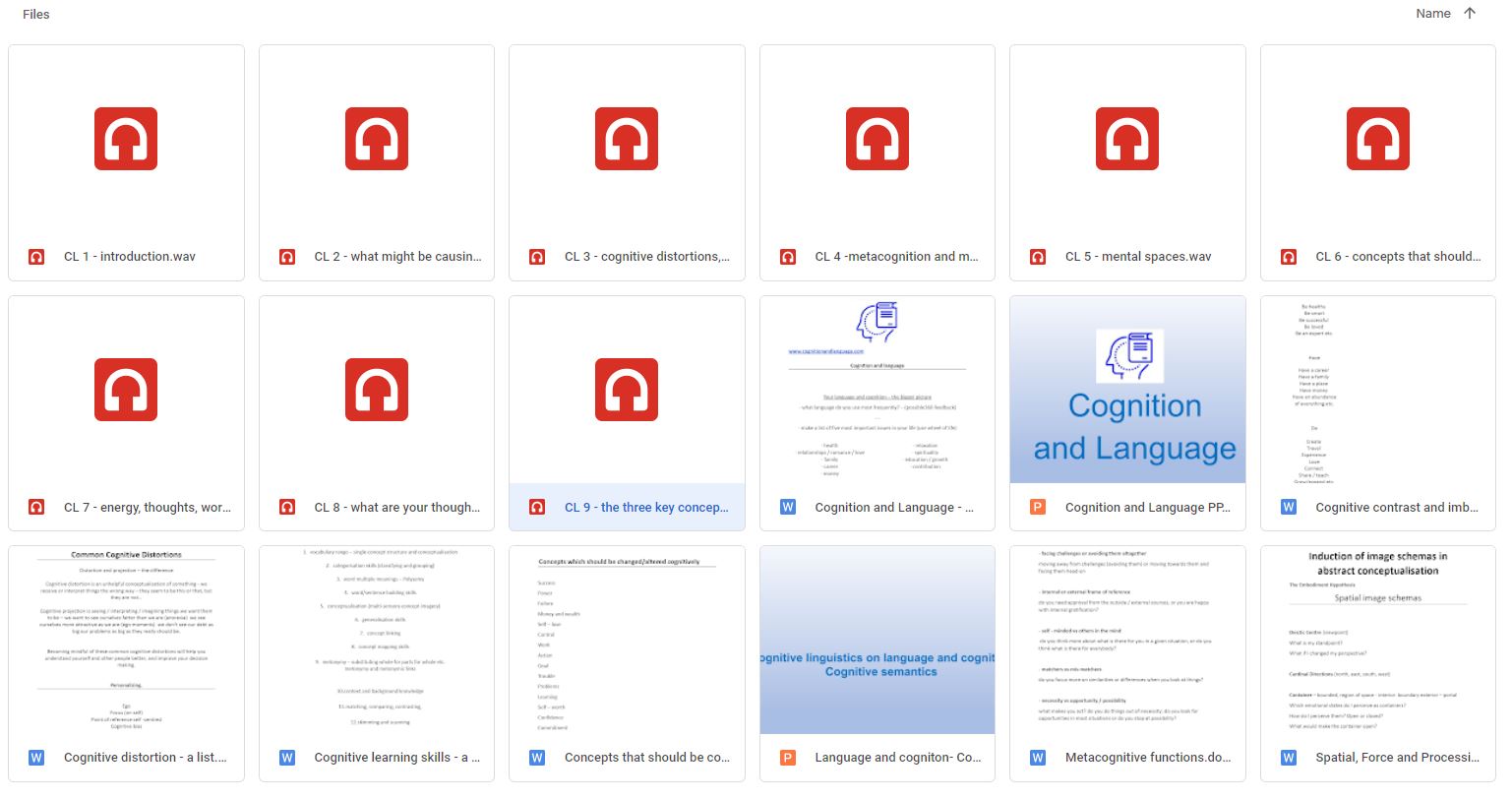
What is included in the download?
√ Cognition and language – presentation slides:
– Cognition and language- cognitive linguistics
– Cognition and language
√ Audio files:
√ Cognition and Language:
– introduction
√ What might be the issue
– cognitive distortions, imbalances and inconsistencies
– metacognition and meta programmes
– mental spaces
– concepts that should be altered
– energy, thoughts words and the outer world
– what are thoughts and emotions, actually?
– the three main keys to conceptualisation
Files:
√ Cognitive distortions, imbalances and inconsistencies
√ Cognitive distortions- a list
√ Cognitive Learning skills
√ Concepts that should be cognitively reframed
√ Event scripts – a list
√ Meta programmes
√ Spatial, Force and processing image schemas
When you purchase this single module, you will be entitled to
free support in a form of online Q&A / AMA sessions in a private Facebook group and
implementation days to guide you through the programme.
You will have to register your interest in these sessions. You will receive all the details in an email after completing the purchase, in due course.
Comment Contact Contribute
Get in touch.

info@cognitionandlanguage.com
Thank you for getting in touch!